Ch. 9 - Biotechnology & DNA Technology
Tortora - Microbiology: An Introduction 14th Edition
Tortora14th EditionMicrobiology: An IntroductionISBN: 9780138200398Non è quello che usi tu?Cambia libro di testo
Capitolo 5, Problema 1

Compare and contrast the following terms:
a. cDNA and gene
b. DNA probe and gene
c. DNA polymerase and DNA ligase
d. rDNA and cDNA
e. genome and proteome

Guida verificata passo dopo passo
1
Step 1: Define each term clearly to establish a foundation for comparison. For example, explain that a gene is a segment of DNA that codes for a functional product, while cDNA (complementary DNA) is synthesized from mRNA and represents only the expressed genes without introns.
Step 2: For each pair, identify the key differences and similarities. For instance, compare a DNA probe (a labeled single-stranded DNA fragment used to detect complementary sequences) with a gene (a functional DNA segment), highlighting their roles and purposes.
Step 3: When comparing enzymes like DNA polymerase and DNA ligase, describe their distinct functions in DNA replication and repair: DNA polymerase synthesizes new DNA strands by adding nucleotides, whereas DNA ligase joins DNA fragments by forming phosphodiester bonds.
Step 4: Contrast recombinant DNA (rDNA), which is artificially created by combining DNA from different sources, with cDNA, which is naturally synthesized from mRNA and lacks non-coding regions, emphasizing their origins and applications.
Step 5: Differentiate between genome (the complete set of genetic material in an organism) and proteome (the entire set of proteins expressed by the genome), explaining how the genome is static while the proteome can vary with conditions and time.

Risposta video verificata per un problema simile:

Questa soluzione video è stata consigliata dai nostri tutor come utile per risolvere questo problema.
Durata del video:
1m

Concetti chiave

Ecco i concetti essenziali che devi comprendere per rispondere correttamente alla domanda.

cDNA and Gene

A gene is a DNA segment that contains the instructions to make a functional product, usually a protein. Complementary DNA (cDNA) is synthesized from mature mRNA using reverse transcriptase and represents only the expressed sequences (exons) without introns. Unlike genomic DNA, cDNA reflects the coding regions actively transcribed in a cell.
Video consigliato:
04:42
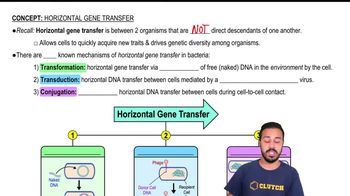
Horizontal Gene Transfer

DNA Probe and Gene

A DNA probe is a short, labeled single-stranded DNA fragment used to detect the presence of a complementary DNA sequence (gene) through hybridization. It helps identify specific genes or sequences within a complex DNA sample by binding only to matching sequences, enabling gene localization or diagnosis.
Video consigliato:
04:42
Horizontal Gene Transfer

DNA Polymerase and DNA Ligase

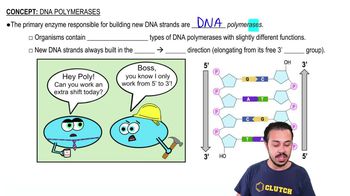
DNA polymerase is an enzyme that synthesizes new DNA strands by adding nucleotides complementary to a template strand during replication. DNA ligase, on the other hand, joins DNA fragments by forming phosphodiester bonds, sealing nicks in the sugar-phosphate backbone, essential for DNA repair and recombinant DNA technology.
Video consigliato:
04:01
DNA Polymerases