 Indietro
Microeconomics: Elasticity Concepts and Applications
 04:56
04:56

Termini in questo insieme (23)
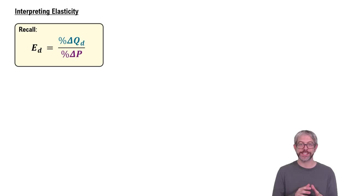
Price Elasticity of Demand measures the responsiveness of quantity demanded to a change in price, calculated as the absolute value of the percentage change in quantity demanded divided by the percentage change in price.
Percentage change in Qd = change in Qd / [(Qd1 + Qd2)/2], Percentage change in P = change in P / [(P1 + P2)/2], then Ed = % change in Qd / % change in P.
Demand is elastic, meaning quantity demanded changes by a greater percentage than the price change.
Demand is inelastic, meaning quantity demanded changes by a smaller percentage than the price change.
When a 1% change in price causes exactly a 1% change in quantity demanded, Ed = 1.
Quantity demanded does not change when price changes, Ed = 0.
Quantity demanded changes infinitely with any price change, Ed = infinity.
Availability of substitutes, proportion of income spent on the good, whether the good is a luxury or necessity, and time consumers have to adjust to price changes.
The more substitutes available, the more elastic the demand because consumers can easily switch goods.
The greater the proportion of income spent, the more elastic the demand, as price changes significantly impact consumers' budgets.
Luxury goods have elastic demand; necessities have inelastic demand.
Demand is more elastic over longer time periods because consumers have more time to adjust their behavior.
If demand is elastic, increasing price decreases total revenue; if inelastic, increasing price increases total revenue.
Price Elasticity of Supply measures responsiveness of quantity supplied to price changes, calculated as % change in quantity supplied divided by % change in price.
Supply is elastic if Es > 1 (quantity supplied changes more than price), inelastic if Es < 1 (quantity supplied changes less than price), often depending on time to adjust production.
Measures responsiveness of quantity demanded to changes in consumer income, calculated as % change in Qd divided by % change in income.
The good is normal; demand increases as income increases.
The good is inferior; demand decreases as income increases.
Luxury goods have Ei > 1; necessity goods have 0 < Ei < 1.
Measures responsiveness of quantity demanded of good X to price changes of good Y, calculated as % change in Qd of X divided by % change in price of Y.
Goods X and Y are substitutes; if price of Y rises, demand for X rises.
Goods X and Y are complements; if price of Y rises, demand for X falls.
Goods X and Y are unrelated; price changes in Y do not affect demand for X.