 Indietro
Microeconomics Principles and Practice Chpater 1
 01:42
01:42

Termini in questo insieme (20)
Economics is the study of people’s choices and how they make decisions among scarce resources.
1. Optimization: choosing the best option.
2. Equilibrium: no one benefits from changing behavior.
3. Empiricism: using data to test theories.
Optimization means making the best choice possible with given information.
Equilibrium is a situation where no one would benefit by changing their own behavior.
Empiricism is evidence-based analysis using data to test economic theories and understand real-world behavior.
An economic agent is any individual or group that makes choices, such as consumers, firms, or governments.
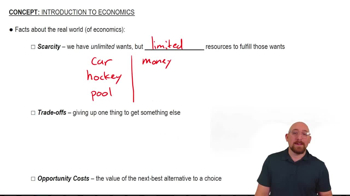
Scarcity means having unlimited wants but limited resources to satisfy them.
A budget constraint is the set of options a person can afford without exceeding their budget.
A trade-off occurs when gaining one benefit requires giving up another.
Opportunity cost is the value of the best alternative foregone when making a choice.
Positive economics describes what people actually do, based on facts and data.
Normative economics recommends what people or society ought to do, involving value judgments.
Economists use data to test theories and determine causes of economic phenomena, applying empiricism.
The free rider problem occurs when someone benefits from a good without paying its cost.
Groups can decide what is fair and apply pressure to free riders to conform, since markets lack fairness mechanisms.
The opportunity cost is \(\(10 \times 2 = 20\)\), or \$20 in foregone wages.
It means everyone is optimizing and no one can improve their outcome by changing behavior.
Microeconomics studies how individuals, firms, and governments make choices.
Macroeconomics studies the economy as a whole.
Economics helps understand costs and benefits, improve decision-making, and think like an economist.