Assumptions simplify reality to focus on key relationships, making models easier to analyze and understand.
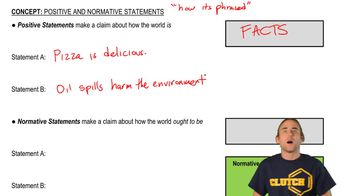
Difference between normative and positive analysis
Positive analysis describes what is and can be tested; normative analysis involves opinions about what ought to be. Economists mainly perform positive analysis.
Distinguish between macroeconomics and microeconomics
Microeconomics studies individual agents and markets; macroeconomics studies the economy as a whole. Key macro terms: inflation, unemployment, GDP.
Does microeconomics make up macroeconomics or vice versa?
Microeconomics makes up macroeconomics; macro aggregates microeconomic behavior.
Define Entrepreneur
An individual who organizes resources to start and operate a business, taking on financial risks.
Define Innovation
The process of creating new products, services, or methods that improve efficiency or value.
Define Technology
The application of scientific knowledge for practical purposes, especially in industry.
Define Firm, Company, or Business
An organization that produces goods or services to sell to consumers.
Define Goods
Physical, tangible products that satisfy human wants or needs.
Define Services
Intangible activities or benefits provided to consumers.
Define Revenue
Total income a firm receives from selling goods or services.
Define Profit
Revenue minus total costs; the financial gain from business activities.
Define Household
Individuals or groups living together who consume goods and services and supply factors of production.
Define Factors of Production
Resources used to produce goods and services: land, labor, capital, and entrepreneurship.
Define Capital
Man-made resources used to produce other goods and services, like machinery and buildings.
Define Human Capital
Skills, knowledge, and experience possessed by an individual or workforce.
What is slope and how is it calculated in the PPF model?
Slope is the rate of trade-off between two goods; calculated as \(\frac{\text{change in } y}{\text{change in } x}\).
What are trade-offs? Give an example.
Trade-offs occur when producing more of one good requires producing less of another, e.g., choosing between guns and butter.
What is a Production Possibilities Frontier (PPF)?
A curve showing maximum output combinations of two goods an economy can produce with available resources.
What points on the PPF are attainable, efficient, inefficient, and unattainable?
Points on the curve are efficient; inside are inefficient; outside are unattainable with current resources.
What causes a PPF to be non-linear?
Increasing marginal opportunity costs cause a bowed-out (non-linear) PPF due to resources not being equally efficient in all uses.
What is economic growth in terms of the PPF?
Economic growth shifts the PPF outward, allowing more production of goods.
Define Absolute Advantage
The ability to produce more of a good with the same resources than another producer.
Define Comparative Advantage
The ability to produce a good at a lower opportunity cost than another producer.
What is the basis for trade?
Trade occurs because of comparative advantage, allowing mutual gains by specializing in lower opportunity cost goods.
What are markets and what three questions do they answer?
Markets are places where buyers and sellers interact to answer: What to produce? How to produce? For whom to produce?
Define market economy
An economy where decisions are made by individuals and firms with little government intervention, e.g., the USA.
Define centrally planned economy
An economy where the government makes all production and distribution decisions, e.g., North Korea.
Define mixed economy
An economy combining market forces and government intervention, e.g., most modern economies.
What is the Law of Demand?
As price falls, quantity demanded rises, ceteris paribus (all else equal).
Why does the demand curve slope downward?
Because lower prices increase quantity demanded due to substitution and income effects.
Difference between change in demand and change in quantity demanded
Change in demand shifts the curve; change in quantity demanded moves along the curve due to price changes.
Five demand curve shifters
Income, prices of related goods, tastes, expectations, and number of buyers.
What is the Law of Supply?
As price rises, quantity supplied rises, ceteris paribus.
Why does the supply curve slope upward?
Higher prices incentivize producers to supply more.
Difference between supply and quantity supplied
Supply is the entire curve; quantity supplied is a point on the curve at a specific price.
Five supply curve shifters
Input prices, technology, expectations, number of sellers, and taxes/subsidies.
What is market equilibrium?
The price where quantity demanded equals quantity supplied; no shortages or surpluses.
What causes shortages and how are they resolved?
Shortages occur when price is below equilibrium; prices rise to restore equilibrium.
What causes surpluses and how are they resolved?
Surpluses occur when price is above equilibrium; prices fall to restore equilibrium.
 Indietro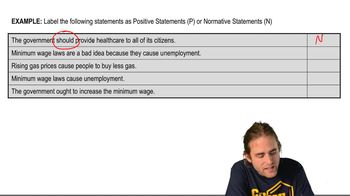
 02:48
02:48