 Indietro
Principles of Microeconomics Exam 1 Key Concepts
 09:36
09:36
Termini in questo insieme (30)
Scarcity means limited resources force people to make choices and trade-offs.
Economics is the study of how people allocate scarce resources to satisfy unlimited wants.
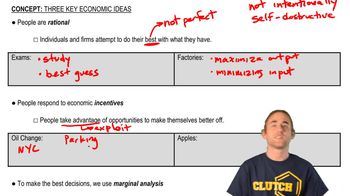
People are rational, respond to incentives, and make optimal decisions at the margin.
Opportunity cost is the value of the next best alternative foregone when making a choice.
What to produce, how to produce, and who receives the goods and services.
Centrally planned economies, market economies, and mixed economies differ by who controls production and distribution.
Positive economics describes what is; normative economics prescribes what ought to be.
Microeconomics studies individual markets; macroeconomics studies the economy as a whole.
The PPF shows combinations of two goods that can be produced efficiently with available resources.
Resources are fixed, technology is constant, and all resources are fully employed.
Efficient points lie on the PPF; inefficient points lie inside; unattainable points lie outside.
Constant means opportunity cost stays the same; increasing means opportunity cost rises as more is produced.
Improvements in technology, increases in resources, or better education shift the PPF outward.
A producer has comparative advantage if they have a lower opportunity cost than others.
A producer has absolute advantage if they can produce more output with the same resources.
Trade allows each party to specialize in goods with comparative advantage, increasing total output and consumption.
A free market is where buyers and sellers freely exchange goods and services with minimal government intervention.
The invisible hand describes how individuals pursuing self-interest can lead to positive social outcomes.
Hayek argued that knowledge is decentralized, making central planning inefficient compared to markets.
Private property rights allow individuals to own and control resources, encouraging investment and trade.
As price falls, quantity demanded rises, ceteris paribus.
Demand is the entire relationship between price and quantity; quantity demanded is a point on the demand curve.
Price changes cause consumers to substitute cheaper goods and affect their purchasing power (income effect).
Income, tastes, prices of related goods, expectations, and number of buyers shift demand.
As price rises, quantity supplied rises, ceteris paribus.
Supply is the entire relationship between price and quantity; quantity supplied is a point on the supply curve.
Input prices, technology, expectations, number of sellers, and taxes/subsidies shift supply.
Equilibrium occurs where quantity demanded equals quantity supplied.
Surplus occurs when quantity supplied > quantity demanded; shortage when quantity demanded > quantity supplied.
Prices adjust to eliminate surpluses and shortages, moving the market back to equilibrium.