 Indietro
Supply, Demand, Price Controls, and Market Efficiency: Microeconomics Study Notes
Guida di studio - Note intelligenti
 Appunti personalizzati basati sui tuoi materiali, ampliati con definizioni chiave, esempi e contesto.
Supply and Demand Applications
The Price System: Rationing and Allocating Resources
The price system is central to how resources are allocated in a market economy. When the quantity demanded exceeds the quantity supplied, price rationing occurs, adjusting prices until the market clears. This mechanism ensures that goods and services are distributed efficiently among consumers.
Price rationing: The process by which the market system allocates goods and services when there is a shortage.
Market clearing price: The price at which quantity supplied equals quantity demanded.
Example: Fires in Russia in 2010 reduced wheat supply, causing prices to rise and the equilibrium to shift.
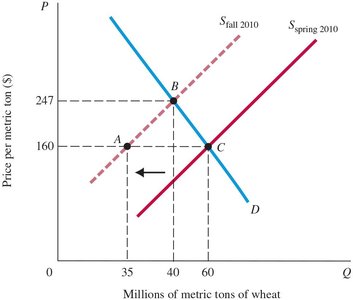
Constraints on the Market and Alternative Rationing Mechanisms
Sometimes, governments or firms use mechanisms other than price to ration goods, especially during shortages. These alternatives, such as price ceilings, queuing, favored customers, ration coupons, and black markets, often lead to unintended consequences and inefficiencies.
Price ceiling: A maximum price set by the government, below which exchange is not permitted.
Queuing: Waiting in line as a nonprice rationing mechanism.
Favored customers: Individuals who receive special treatment during shortages.
Ration coupons: Tickets allowing purchase of limited quantities.
Black market: Illegal trading at market-determined prices.
Example: OPEC oil embargo in 1973-74 led to U.S. price ceilings and shortages, requiring alternative rationing systems.
Price Floors
Price floors are minimum prices set by governments, below which exchange is not allowed. Common examples include minimum wage laws. Price floors can lead to surpluses if set above the equilibrium price.
Price floor: Minimum allowable price for a good or service.
Minimum wage: A price floor for labor.
Supply and Demand Analysis: Tariffs
Tariffs and Market Effects
Tariffs are taxes on imported goods. Supply and demand analysis helps understand their impact: tariffs raise domestic prices, reduce imports, and increase domestic production. This can lead to inefficiencies and changes in consumer and producer surplus.
Tariff: Tax on goods produced outside the country.
Effect: Increases domestic price, reduces imports, and encourages domestic production.
Example: U.S. crude oil market with and without an import fee.
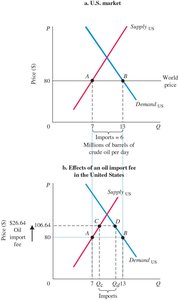
Supply and Demand and Market Efficiency
Consumer Surplus
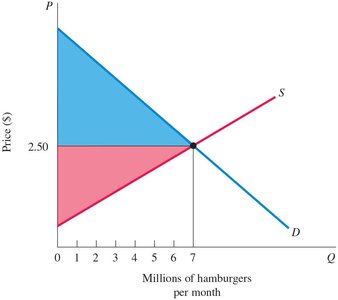
Consumer surplus is the difference between what consumers are willing to pay and what they actually pay. It represents the net benefit to consumers from market transactions.
Consumer surplus: Maximum willingness to pay minus market price.
Graphical representation: Area above the market price and below the demand curve.
Example: Some consumers are willing to pay $5 for a hamburger, but the market price is $2.50, resulting in a surplus.
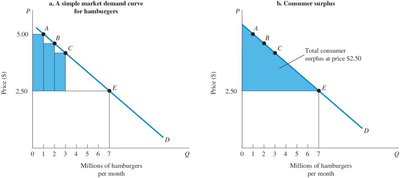
Producer Surplus
Producer surplus is the difference between the market price and the minimum price at which producers are willing to supply a good. It measures the net benefit to producers.
Producer surplus: Market price minus cost of production.
Graphical representation: Area below the market price and above the supply curve.
Example: Producers willing to supply hamburgers at $0.75 but receive $2.50, earning a surplus.
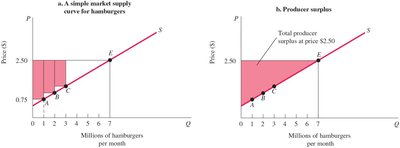
Market Efficiency and Deadweight Loss
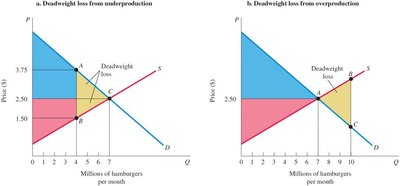
Competitive markets maximize the sum of consumer and producer surplus. Deadweight loss occurs when markets are not at equilibrium, resulting in lost welfare due to underproduction or overproduction.
Deadweight loss: Total loss of surplus from inefficient production levels.
Graphical representation: Area representing lost surplus when production deviates from equilibrium.
Example: Producing fewer or more hamburgers than equilibrium reduces total surplus.
Potential Causes of Deadweight Loss
Market failures can cause deadweight loss. These include monopoly power, taxes and subsidies, externalities, and artificial price controls. Efficient markets require free interaction of supply and demand.
Monopoly power: Leads to underproduction and higher prices.
Taxes and subsidies: Distort consumer and producer choices.
External costs: Pollution and congestion can cause inefficiency.
Price floors and ceilings: Artificial controls can lead to deadweight loss.
Applications and Examples
Used Car Prices During the COVID-19 Pandemic
Supply chain disruptions, such as shortages of semiconductor chips, reduced the supply of new cars during the COVID-19 pandemic. This led to higher prices for new cars and increased demand for used cars, causing used car prices to rise.
Example: When supply of new cars fell, consumers substituted used cars, increasing their prices.

Concert and Sports Ticket Rationing
Attempts to use nonprice rationing for tickets often fail, as willingness to pay asserts itself through favored customers and black markets. Price rationing remains the most efficient mechanism.
Example: Excess demand for concert tickets at face value leads to alternative rationing and potential unfairness.
Key Formulas
Consumer Surplus:
Producer Surplus:
Deadweight Loss:
Summary Table: Price Controls and Market Outcomes
Type | Definition | Effect |
|---|---|---|
Price Ceiling | Maximum price allowed | Shortage, alternative rationing |
Price Floor | Minimum price allowed | Surplus, inefficiency |
Tariff | Tax on imports | Higher prices, reduced imports |
Consumer Surplus | Willingness to pay minus price | Net benefit to consumers |
Producer Surplus | Price minus cost of production | Net benefit to producers |
Deadweight Loss | Lost surplus from inefficiency | Reduced welfare |
