Skip to main content
Nutrition
Il mio corso
Impara
Preparazione agli esami
AI Tutor
Guide di studio
Flashcard
Prova l'app
Il mio corso
Impara
Preparazione agli esami
AI Tutor
Guide di studio
Flashcard
Prova l'app
Indietro
Blood Glucose Regulation exam
Puoi toccare per girare la carta.
What is hyperglycemia?
Puoi toccare per girare la carta.
👆
What is hyperglycemia?
A condition where blood glucose levels are too high.
Avanzamenti del tracciato
I pulsanti di controllo sono stati cambiati in modalità "navigazione".
1/29
Flashcard correlate
Pratica correlata
Video consigliati
Blood Glucose Regulation definitions
Blood Glucose Regulation
15 Termini
Blood Glucose Regulation quiz
Blood Glucose Regulation
15 Termini
Blood Glucose Regulation
4. Carbohydrates
10 Problemi
Argomento
Diabetes
4. Carbohydrates
10 Problemi
Argomento
4. Carbohydrates
9 Argomenti
15 Problemi
Capitolo
VideoThumbView.guidedCourse
03:15
Glucagon Increases Blood Glucose Levels
268
views
1
rank
VideoThumbView.guidedCourse
02:45
Blood Glucose Regulation Example 1
214
views
4
rank
VideoThumbView.guidedCourse
02:15
Blood Glucose Regulation
266
views
3
rank
Termini in questo insieme (29)
Nascondere definizioni
What is hyperglycemia?
A condition where blood glucose levels are too high.
Insulin
A hormone that decreases blood glucose by promoting glucose uptake and glycogenesis.
What does hypoglycemia mean?
It means blood glucose levels are too low.
Glucagon
A hormone that increases blood glucose by stimulating glycogenolysis and gluconeogenesis.
What organ secretes insulin?
The pancreas.
Glycogenesis
The process of generating glycogen from glucose for storage.
What is the main effect of insulin after a carbohydrate-rich meal?
It lowers blood glucose by promoting glucose uptake and storage.
Glycogenolysis
The breakdown of glycogen into glucose.
What triggers glucagon secretion?
Low blood glucose, such as during fasting or between meals.
Gluconeogenesis
The generation of glucose from non-carbohydrate sources.
What is the effect of glucagon on the liver?
It stimulates glycogenolysis and gluconeogenesis to increase blood glucose.
Lipogenesis
The process of generating lipids (fats) from excess glucose.
What happens if blood glucose is not regulated?
It can lead to serious health issues like organ damage or loss of consciousness.
Lipolysis
The breakdown of lipids (fats) to release energy.
Which hormone stimulates lipogenesis?
Insulin.
What are symptoms of hypoglycemia?
Dizziness, confusion, and potentially loss of consciousness.
Which hormone stimulates lipolysis?
Glucagon.
What is the storage form of glucose in the body?
Glycogen.
How does insulin affect glucose transporters?
It stimulates their expression on cell membranes, increasing glucose uptake.
What other hormones can increase blood glucose besides glucagon?
Epinephrine, norepinephrine, cortisol, and growth hormone.
What is the main goal of blood glucose regulation?
To maintain blood glucose within a narrow, healthy range.
What is the effect of insulin on skeletal muscle?
It promotes glucose uptake and glycogenesis.
What is the effect of glucagon during fasting?
It increases blood glucose by stimulating glycogenolysis and gluconeogenesis.
What can cause hyperglycemia?
Excessive carbohydrate intake or insufficient insulin action.
What is the role of the pancreas in blood glucose regulation?
It secretes insulin and glucagon to regulate blood glucose.
How does physical activity affect blood glucose?
It helps maintain blood glucose balance.
What is the consequence of chronic hyperglycemia?
It can cause dehydration, organ damage, and skin infections.
What is the primary energy source for the brain?
Glucose.
How does glucagon help during low blood glucose?
It stimulates the liver to release glucose into the blood.
 IndietroIndietro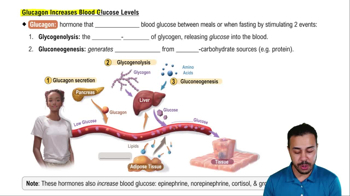
 03:15
03:15