Skip to main content
Nutrition
Il mio corso
Impara
Preparazione agli esami
AI Tutor
Guide di studio
Flashcard
Prova l'app
Il mio corso
Impara
Preparazione agli esami
AI Tutor
Guide di studio
Flashcard
Prova l'app
Indietro
Energy in Food exam
Puoi toccare per girare la carta.
What is metabolism?
Puoi toccare per girare la carta.
👆
What is metabolism?
The set of chemical reactions that break down and use food molecules to release energy in cells.
Avanzamenti del tracciato
I pulsanti di controllo sono stati cambiati in modalità "navigazione".
1/29
Flashcard correlate
Pratica correlata
Video consigliati
Energy in Food definitions
Energy in Food
15 Termini
Energy in Food quiz
Energy in Food
15 Termini
Energy in Food quiz #1
Energy in Food
30 Termini
Energy in Food
1. Science of Nutrition
10 Problemi
Argomento
Nutrition as a Science
1. Science of Nutrition
10 Problemi
Argomento
1. Science of Nutrition
8 Argomenti
15 Problemi
Capitolo
04:10
Defining Calories
626
views
29
rank
04:06
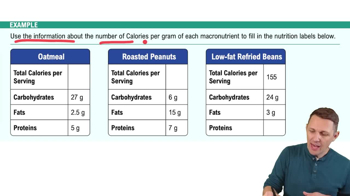
Energy in Food Example 1
490
views
13
rank
03:18
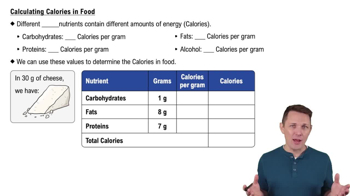
Calculating Calories in Food
592
views
25
rank
Termini in questo insieme (29)
Nascondere definizioni
What is metabolism?
The set of chemical reactions that break down and use food molecules to release energy in cells.
Calorie (lowercase 'c')
The energy needed to heat 1 gram of water by 1°C.
How many calories per gram do carbohydrates provide?
4 calories per gram.
Kilocalorie (kcal)
Equal to 1,000 little 'c' calories; also called a Calorie (uppercase 'C').
What is the technical definition of a Calorie (uppercase 'C')?
The energy needed to heat 1 liter of water by 1°C; equal to 1,000 little 'c' calories.
How many calories per gram do fats provide?
9 calories per gram.
What is the main source of energy in food?
Macronutrients: carbohydrates, proteins, and fats.
How do you calculate total calories in a food item?
Multiply grams of each macronutrient by their calories per gram, then sum the results.
Protein
A macronutrient that provides 4 calories per gram.
Why don't the grams of macronutrients always add up to the total weight of food?
Because foods contain other components like water, which add weight but not calories.
What unit is used on nutrition labels to indicate energy?
Calories (uppercase 'C'), which are kilocalories.
Alcohol (energy value)
Provides 7 calories per gram, though it is not a macronutrient.
What is the energy value of protein per gram?
4 calories per gram.
Why is fat considered energy-rich?
Because it provides more than twice as much energy per gram as carbohydrates or protein.
How much energy is in a 2,000 Calorie diet?
Enough to raise 20 liters of water from freezing to boiling.
Carbohydrate
A macronutrient that provides 4 calories per gram.
What is the difference between a calorie and a Calorie?
A calorie (c) heats 1g of water by 1°C; a Calorie (C) or kilocalorie heats 1L of water by 1°C and equals 1,000 calories.
How do you find calories from fat in a food item?
Multiply grams of fat by 9.
Why are big 'C' Calories used in nutrition instead of little 'c' calories?
Because food contains much more energy, making kilocalories (big 'C') a more practical unit.
What does 'kcal' stand for?
Kilocalorie, equal to 1,000 little 'c' calories.
If a food has 5g carbs, 3g fat, and 2g protein, how many total calories does it have?
5x4 + 3x9 + 2x4 = 20 + 27 + 8 = 55 total calories.
What is the energy value of alcohol per gram?
7 calories per gram.
What is the main purpose of measuring calories in food?
To quantify the energy available from food for the body.
How are calories in food related to energy balance?
They help determine energy intake, which is crucial for maintaining, losing, or gaining weight.
Fat
A macronutrient that provides 9 calories per gram.
What is the benchmark daily calorie intake often used?
2,000 Calories per day.
What does metabolism do with macronutrients?
Breaks them down to release energy measured in calories.
How do you calculate calories from protein in a food item?
Multiply grams of protein by 4.
Why might a food's total weight be higher than the sum of its macronutrients?
Because of non-caloric components like water.
 IndietroIndietro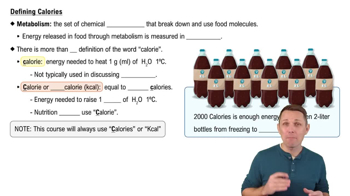
 04:10
04:10