Skip to main content
Nutrition
Il mio corso
Impara
Preparazione agli esami
AI Tutor
Guide di studio
Flashcard
Prova l'app
Il mio corso
Impara
Preparazione agli esami
AI Tutor
Guide di studio
Flashcard
Prova l'app
Indietro
Exercise exam
Puoi toccare per girare la carta.
What are the three main types of exercise?
Puoi toccare per girare la carta.
👆
What are the three main types of exercise?
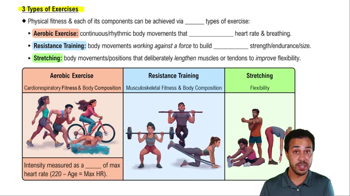
Aerobic exercise, resistance training, and stretching.
Avanzamenti del tracciato
I pulsanti di controllo sono stati cambiati in modalità "navigazione".
1/30
Flashcard correlate
Pratica correlata
Video consigliati
Exercise definitions
Exercise
15 Termini
Exercise quiz
Exercise
15 Termini
Exercise quiz #1
Exercise
10 Termini
Exercise
11. Nutrition & Fitness
10 Problemi
Argomento
Using Energy to Fuel Exercise
11. Nutrition & Fitness
10 Problemi
Argomento
11. Nutrition & Fitness
5 Argomenti
15 Problemi
Capitolo
VideoThumbView.guidedCourse
01:39
Exercise Example 1
131
views
1
rank
VideoThumbView.guidedCourse
02:17
Designing an Exercise Program
140
views
1
rank
VideoThumbView.guidedCourse
02:17
3 Types of Exercises
155
views
2
rank
Termini in questo insieme (30)
Nascondere definizioni
What are the three main types of exercise?
Aerobic exercise, resistance training, and stretching.
Aerobic Exercise
Continuous, rhythmic movements that increase heart rate and breathing, improving cardiorespiratory fitness.
What is the primary benefit of resistance training?
It builds muscle strength, endurance, size, and bone density.
Stretching
Body movements or positions that lengthen muscles or tendons to improve flexibility.
How do you estimate your maximum heart rate?
Subtract your age from 220.
Cardiorespiratory Fitness
The ability of the heart and lungs to supply oxygen during sustained physical activity.
What is the FIT principle?
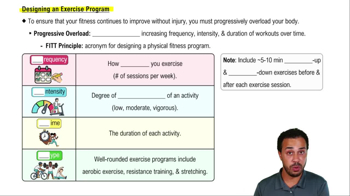
A guideline for exercise program design: Frequency, Intensity, Time, and Type.
What is progressive overload?
Gradually increasing exercise frequency, intensity, and duration to improve fitness and prevent plateau.
Body Composition
The proportion of fat and non-fat mass in the body.
What is the recommended minimum amount of moderate aerobic activity per week for adults?
At least 150 minutes.
Resistance Training
Exercise involving working against a force to build muscle and bone strength.
Why is flexibility important?
It is critical for all types of exercise and many daily activities.
What are examples of aerobic exercise?
Walking, running, biking, and swimming.
What is the benefit of a warm-up before exercise?
Prepares the mind and body for exertion and reduces injury risk.
Musculoskeletal Fitness
The strength, endurance, and health of muscles and bones.
What is the purpose of a cooldown after exercise?
Gradually lowers heart rate and aids recovery.
What percentage of maximum heart rate defines moderate aerobic activity?
50% to 70% of maximum heart rate.
What are the benefits of regular exercise?
Reduces risk of obesity, heart disease, type 2 diabetes, some cancers, and improves mental and bone health.
How often should muscle-strengthening activities be performed per week?
At least two sessions targeting major muscle groups.
Vigorous Aerobic Activity
Exercise that raises heart rate to 70%–85% of maximum heart rate.
What is the minimum recommended time for vigorous aerobic activity per week?
75 minutes.
Why is gradual progression in exercise important?
To prevent injury and ensure continuous improvement.
What does the 'I' in FIT stand for?
Intensity—the degree of difficulty of the activity.
What is the role of stretching in a fitness program?
Improves flexibility and supports overall fitness.
What does the 'F' in FIT stand for?
Frequency—how often you exercise.
What does the 'T' in FIT stand for (first T)?
Time—the duration of each exercise session.
Is some exercise better than none?
Yes, any exercise is better than none and provides health benefits.
What is the main focus of resistance training?
Building musculoskeletal fitness and improving body composition.
What is the main focus of aerobic exercise?
Improving cardiorespiratory fitness and body composition.
What is the main focus of stretching?
Improving flexibility.
 IndietroIndietro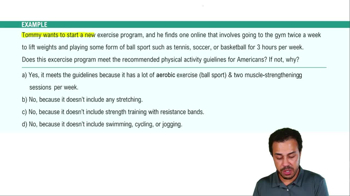
 01:39
01:39