Skip to main content
Nutrition
Il mio corso
Impara
Preparazione agli esami
AI Tutor
Guide di studio
Flashcard
Prova l'app
Il mio corso
Impara
Preparazione agli esami
AI Tutor
Guide di studio
Flashcard
Prova l'app
Indietro
Hunger, Satiety, and Hormones quiz
Puoi toccare per girare la carta.
What is the physiological drive to eat called?
Puoi toccare per girare la carta.
👆
What is the physiological drive to eat called?
The physiological drive to eat is called hunger, which is distinct from appetite.
Avanzamenti del tracciato
I pulsanti di controllo sono stati cambiati in modalità "navigazione".
1/15
Flashcard correlate
Pratica correlata
Video consigliati
Hunger, Satiety, and Hormones definitions
Hunger, Satiety, and Hormones
15 Termini
Hunger, Satiety, and Hormones exam
Hunger, Satiety, and Hormones
28 Termini
Hunger, Satiety, and Hormones quiz #1
Hunger, Satiety, and Hormones
10 Termini
Hunger, Satiety, and Hormones
3. The Human Body & Digestion
10 Problemi
Argomento
Overview of the Digestive System
3. The Human Body & Digestion
10 Problemi
Argomento
3. The Human Body & Digestion
7 Argomenti
15 Problemi
Capitolo
05:40
Hunger and Satiety
645
views
15
rank
06:08
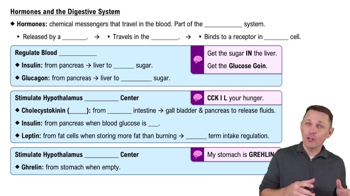
Hormones and the Digestive System
431
views
8
rank
02:04
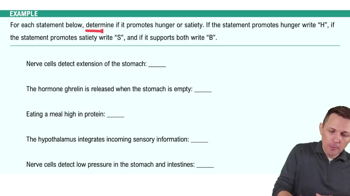
Hunger, Satiety, and Hormones Example 1
398
views
12
rank
Termini in questo insieme (15)
Nascondere definizioni
What is the physiological drive to eat called?
The physiological drive to eat is called hunger, which is distinct from appetite.
How does appetite differ from hunger?
Appetite is the desire to eat food, often stimulated by external cues like sights and smells, while hunger is a physiological need for food.
What is satiety?
Satiety is the feeling of fullness that signals you to stop eating.
Which region of the brain integrates signals of hunger and satiety?
The hypothalamus integrates signals from hormones, nerve cells, and nutrients to regulate hunger and satiety.
What are the two centers in the hypothalamus that regulate eating behavior?
The hypothalamus contains a feeding center that stimulates hunger and a satiety center that promotes fullness.
What are hormones and how do they function in the body?
Hormones are chemical messengers released into the blood by glands, and they act on target cells with specific receptors.
Which hormone is released from the stomach to stimulate hunger?
Ghrelin is released from the stomach when it is empty and stimulates the hypothalamus feeding center to promote hunger.
What is the main function of cholecystokinin (CCK) in hunger regulation?
CCK is released from the small intestine when food enters and signals the brain to promote satiety, reducing the desire to eat.
How does insulin contribute to satiety?
Insulin is released from the pancreas when blood glucose is high and signals the satiety center in the hypothalamus to reduce hunger.
What is leptin and what role does it play in energy regulation?
Leptin is a hormone released from fat cells when they store more fat, signaling the brain to decrease hunger and regulate long-term energy balance.
Which nutrients are most effective at promoting satiety?
Protein and fiber are most effective at promoting satiety, making you feel full faster compared to fats or carbohydrates.
How do nerve cells in the digestive system contribute to hunger and satiety?
Nerve cells detect pressure in the stomach and small intestine and send signals to the brain about whether these organs are empty or full.
What is the role of insulin in blood glucose regulation?
Insulin is released when blood glucose is high and signals the liver to store glucose, lowering blood sugar levels.
What is the function of glucagon in the body?
Glucagon is released when blood glucose is low and signals the liver to release stored glucose, raising blood sugar levels.
How does fiber promote satiety?
Fiber is undigestible plant matter that adds bulk to the digestive tract, physically filling you up and promoting a feeling of fullness.
 IndietroIndietro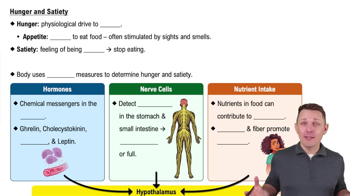
 05:40
05:40