Skip to main content
Nutrition
Il mio corso
Impara
Preparazione agli esami
AI Tutor
Guide di studio
Flashcard
Prova l'app
Il mio corso
Impara
Preparazione agli esami
AI Tutor
Guide di studio
Flashcard
Prova l'app
Indietro
Intro to Carbohydrates quiz
Puoi toccare per girare la carta.
What are the three macronutrients?
Puoi toccare per girare la carta.
👆
What are the three macronutrients?
The three macronutrients are carbohydrates, proteins, and lipids.
Avanzamenti del tracciato
I pulsanti di controllo sono stati cambiati in modalità "navigazione".
1/15
Flashcard correlate
Pratica correlata
Video consigliati
Intro to Carbohydrates definitions
Intro to Carbohydrates
15 Termini
Intro to Carbohydrates exam
Intro to Carbohydrates
29 Termini
Intro to Carbohydrates
4. Carbohydrates
10 Problemi
Argomento
Simple vs Complex Carbohydrates
4. Carbohydrates
10 Problemi
Argomento
4. Carbohydrates
9 Argomenti
15 Problemi
Capitolo
VideoThumbView.guidedCourse
01:35
Sources of Carbohydrates
408
views
10
rank
VideoThumbView.guidedCourse
03:34
What are Carbohydrates?
683
views
22
rank
VideoThumbView.guidedCourse
03:40
Intro to Carbohydrates Example 1
442
views
13
rank
Termini in questo insieme (15)
Nascondere definizioni
What are the three macronutrients?
The three macronutrients are carbohydrates, proteins, and lipids.
What is the basic chemical ratio found in carbohydrates?
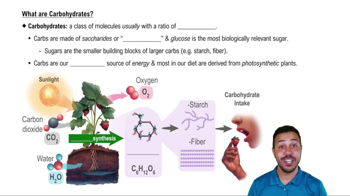
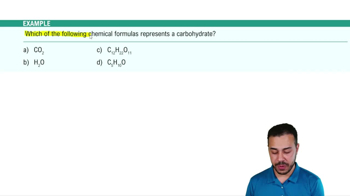
Carbohydrates typically have a ratio of one carbon atom for every water molecule.
What are saccharides?
Saccharides are sugars that make up carbohydrates.
Which sugar is the most biologically relevant in carbohydrates?
Glucose is the most biologically relevant sugar in carbohydrates.
What are the major sources of carbohydrates in our diet?
The major sources are starch, fiber, and sugars.
What is the primary function of carbohydrates in the body?
Carbohydrates serve as the primary source of energy for the body.
From what process do most dietary carbohydrates originate?
Most dietary carbohydrates originate from photosynthesis in plants.
What raw ingredients are used in photosynthesis to create carbohydrates?
Photosynthesis uses carbon dioxide, water, and sunlight to create carbohydrates.
What is the chemical formula for glucose?
The chemical formula for glucose is C6H12O6.
Name three food groups that are common sources of carbohydrates.
Fruits, vegetables, and grains are common sources of carbohydrates.
Which types of foods are exceptions and contain little to no carbohydrates?
Pure protein foods like plain chicken or fish, and pure fat foods like butter or oil, contain little to no carbohydrates.
What does 'nutrient dense' mean in relation to carbohydrates?
Nutrient dense means the food has lots of nutrients but few calories.
Are all carbohydrates equally nutritious?
No, not all carbohydrates are equally nutritious; nutrient-dense options are more healthful.
What are the two main types of carbohydrates students should understand?
Students should understand simple and complex carbohydrates.
What byproduct is released during photosynthesis along with carbohydrates?
Oxygen gas (O2) is released as a byproduct during photosynthesis.
 IndietroIndietro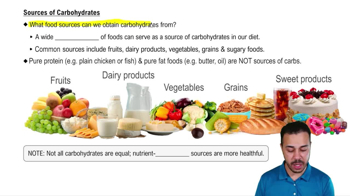
 01:35
01:35