Skip to main content
Nutrition
Il mio corso
Impara
Preparazione agli esami
AI Tutor
Guide di studio
Flashcard
Prova l'app
Il mio corso
Impara
Preparazione agli esami
AI Tutor
Guide di studio
Flashcard
Prova l'app
Indietro
Introduction to Minerals definitions
Puoi toccare per girare la carta.
Mineral
Puoi toccare per girare la carta.
👆
Mineral
Essential inorganic micronutrient, found as a chemical element on the periodic table, required for various physiological functions.
Avanzamenti del tracciato
I pulsanti di controllo sono stati cambiati in modalità "navigazione".
1/15
Flashcard correlate
Pratica correlata
Video consigliati
Introduction to Minerals quiz
Introduction to Minerals
15 Termini
Introduction to Minerals exam
Introduction to Minerals
28 Termini
Introduction to Minerals quiz #1
Introduction to Minerals
16 Termini
Introduction to Minerals
8. Water and Minerals
10 Problemi
Argomento
Major Mineral: Sodium and Potassium
8. Water and Minerals
10 Problemi
Argomento
8. Water and Minerals
10 Argomenti
15 Problemi
Capitolo
05:33
Minerals
234
views
1
rank
02:03
Introduction to Minerals Example 1
183
views
Termini in questo insieme (15)
Nascondere definizioni
Mineral
Essential inorganic micronutrient, found as a chemical element on the periodic table, required for various physiological functions.
Major Mineral
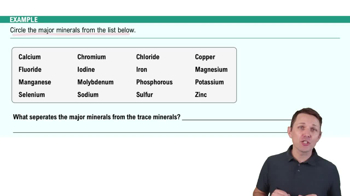
Type of inorganic nutrient needed in amounts greater than 100 milligrams daily, includes elements like sodium and calcium.
Trace Mineral
Type of inorganic nutrient required in amounts less than 100 milligrams daily, includes elements like iron and zinc.
Micronutrient
Nutrient required in small quantities for health, includes both vitamins and minerals, essential for body processes.
Electrolyte
Mineral that dissolves in water to form ions, crucial for water balance and electrical signaling in nerves and muscles.
Ion
Electrically charged atom resulting from a gain or loss of electrons, vital for transmitting electrical signals in the body.
Sodium
Major mineral and key electrolyte, essential for water balance and nerve and muscle function.
Potassium
Major mineral and primary intracellular electrolyte, important for nerve impulses and muscle contraction.
Calcium
Major mineral with a structural role in bones and teeth, also involved in muscle function and signaling.
Phosphorus
Major mineral, component of bones and teeth, also part of energy molecules like ATP.
Chloride
Major mineral and electrolyte, helps maintain fluid balance and is part of stomach acid.
Magnesium
Major mineral, acts as a cofactor for many enzymes and supports muscle and nerve function.
Sulfur
Major mineral, component of certain amino acids and vitamins, important for protein structure.
Enzyme Cofactor
Non-protein chemical, often a mineral, required for enzyme activity and metabolic reactions.
Water Balance
Regulation of body fluids, maintained by electrolytes like sodium and potassium, essential for cellular function.
 IndietroIndietro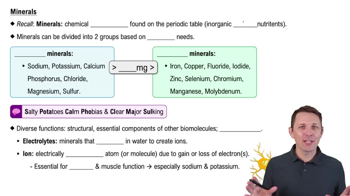
 05:33
05:33