Skip to main content
Nutrition
Il mio corso
Impara
Preparazione agli esami
AI Tutor
Guide di studio
Flashcard
Prova l'app
Il mio corso
Impara
Preparazione agli esami
AI Tutor
Guide di studio
Flashcard
Prova l'app
Indietro
Introduction to Vitamins definitions
Puoi toccare per girare la carta.
Micronutrient
Puoi toccare per girare la carta.
👆
Micronutrient
A nutrient required in small amounts, such as vitamins and minerals, essential for maintaining health and proper body function.
Avanzamenti del tracciato
I pulsanti di controllo sono stati cambiati in modalità "navigazione".
1/15
Flashcard correlate
Pratica correlata
Video consigliati
Introduction to Vitamins quiz
Introduction to Vitamins
15 Termini
Introduction to Vitamins exam
Introduction to Vitamins
29 Termini
Introduction to Vitamins quiz #1
Introduction to Vitamins
10 Termini
Introduction to Vitamins
7. Vitamins
10 Problemi
Argomento
Fat-Soluble Vitamins
7. Vitamins
10 Problemi
Argomento
7. Vitamins
5 Argomenti
15 Problemi
Capitolo
VideoThumbView.guidedCourse
05:25
What are Vitamins?
478
views
13
rank
VideoThumbView.guidedCourse
01:32
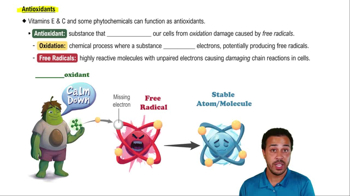
Antioxidants
291
views
4
rank
VideoThumbView.guidedCourse
03:29
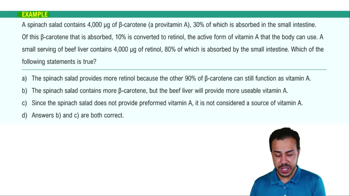
Introduction to Vitamins Example 1
225
views
3
rank
Termini in questo insieme (15)
Nascondere definizioni
Micronutrient
A nutrient required in small amounts, such as vitamins and minerals, essential for maintaining health and proper body function.
Fat-Soluble Vitamin
A type of vitamin, including A, D, E, and K, that dissolves in fats and is stored in body tissues for longer periods.
Water-Soluble Vitamin
A vitamin, such as B vitamins and C, that dissolves in water and is not stored extensively in the body, requiring regular intake.
Provitamin
An inactive precursor found in foods that must be converted by the body into an active vitamin form before use.
Preformed Vitamin
A vitamin already in its active, usable form in foods, allowing immediate utilization by the body after absorption.
Bioavailability
The percentage of a consumed vitamin that is actually absorbed and available for use in the body, often lower for plant sources.
Antioxidant
A substance, such as certain vitamins, that protects cells by neutralizing free radicals and preventing oxidative damage.
Free Radical
A highly reactive molecule with an unpaired electron that can damage cell membranes, proteins, and DNA through chain reactions.
Oxidation
A chemical process involving the loss of electrons, often producing free radicals that can harm cellular components.
Essential Nutrient
A dietary component that must be obtained from food because the body cannot synthesize enough to meet its needs.
Non-Caloric
A property of a substance, like vitamins, indicating it does not provide energy or calories when consumed.
Vitamin Naming System
A convention using letters and numbers, often reflecting discovery order, with gaps due to reclassification of some compounds.
Chemical Name
The scientific designation for a vitamin, such as thiamine for vitamin B1, used alongside its letter or number name.
Plant-Based Vitamin
A vitamin source derived from plants, often less bioavailable compared to animal-based sources due to differences in absorption.
Animal-Based Vitamin
A vitamin source from animal products, typically more bioavailable and readily absorbed than plant-based counterparts.
 IndietroIndietro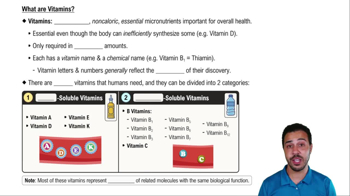
 05:25
05:25