Skip to main content
Nutrition
Il mio corso
Impara
Preparazione agli esami
AI Tutor
Guide di studio
Flashcard
Prova l'app
Il mio corso
Impara
Preparazione agli esami
AI Tutor
Guide di studio
Flashcard
Prova l'app
Indietro
Macronutrients quiz
Puoi toccare per girare la carta.
What are the three classes of macronutrients?
Puoi toccare per girare la carta.
👆
What are the three classes of macronutrients?
The three classes of macronutrients are carbohydrates, lipids (fats), and proteins.
Avanzamenti del tracciato
I pulsanti di controllo sono stati cambiati in modalità "navigazione".
1/15
Flashcard correlate
Pratica correlata
Video consigliati
Macronutrients definitions
Macronutrients
14 Termini
Macronutrients exam
Macronutrients
29 Termini
Macronutrients quiz #1
Macronutrients
10 Termini
Macronutrients
1. Science of Nutrition
10 Problemi
Argomento
Micronutrients
1. Science of Nutrition
10 Problemi
Argomento
1. Science of Nutrition
8 Argomenti
15 Problemi
Capitolo
02:38
Macronutrients Example 1
642
views
19
rank
06:10
Carbohydrates, Lipids, & Protein
939
views
30
rank
Termini in questo insieme (15)
Nascondere definizioni
What are the three classes of macronutrients?
The three classes of macronutrients are carbohydrates, lipids (fats), and proteins.
What elements make up carbohydrates?
Carbohydrates are made of carbon, hydrogen, and oxygen.
What is the primary function of carbohydrates in the body?
Carbohydrates serve as the body's preferred and main source of cellular energy.
Where are carbohydrates primarily found in the diet?
Carbohydrates are primarily found in plant foods such as whole grains, fruits, and vegetables.
What are carbohydrates broken down into during digestion?
Carbohydrates are broken down into simple sugars, such as glucose, during digestion.
What elements make up lipids (fats)?
Lipids are made of carbon, hydrogen, and oxygen.
What is the main structural component of fats?
Fats are composed of long chains of carbon and hydrogen called fatty acids.
How are fats stored in the body?
Fats are stored in the body as triglycerides, which are made of three fatty acids.
What is the preferred use of fats in the body?
Fats are primarily used for energy during low-intensity exercise and for long-term energy storage.
What is the difference between fats and oils in the diet?
Fats are solid at room temperature (found in animal fat and butter), while oils are liquid (found in vegetable oils).
What additional element do proteins contain that carbohydrates and fats do not?
Proteins contain nitrogen, in addition to carbon, hydrogen, and oxygen.
What are the building blocks of proteins?
Proteins are made of long chains of amino acids.
What happens to proteins during digestion?
Proteins are broken down into individual amino acids during digestion.
What is the primary function of proteins in the body?
Proteins are mainly used to build and repair tissues, but can also be used for energy if needed.
What are common dietary sources of protein?
Common sources of protein include meat, dairy, seeds, nuts, and legumes (such as beans).
 IndietroIndietro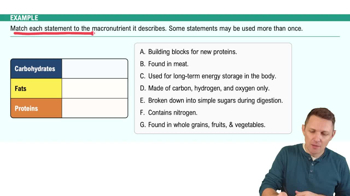
 02:38
02:38