Skip to main content
Nutrition
Il mio corso
Impara
Preparazione agli esami
AI Tutor
Guide di studio
Flashcard
Prova l'app
Il mio corso
Impara
Preparazione agli esami
AI Tutor
Guide di studio
Flashcard
Prova l'app
Indietro
Major Mineral: Calcium and Phosphorus quiz
Puoi toccare per girare la carta.
What mineral forms hydroxyapatite with phosphorus to strengthen bones and teeth?
Puoi toccare per girare la carta.
👆
What mineral forms hydroxyapatite with phosphorus to strengthen bones and teeth?
Calcium forms hydroxyapatite with phosphorus, which is the hard part of bones and teeth.
Avanzamenti del tracciato
I pulsanti di controllo sono stati cambiati in modalità "navigazione".
1/15
Flashcard correlate
Pratica correlata
Video consigliati
Major Mineral: Calcium and Phosphorus definitions
Major Mineral: Calcium and Phosphorus
15 Termini
Major Mineral: Calcium and Phosphorus exam
Major Mineral: Calcium and Phosphorus
29 Termini
Major Mineral: Calcium and Phosphorus quiz #1
Major Mineral: Calcium and Phosphorus
10 Termini
Major Mineral: Calcium and Phosphorus
8. Water and Minerals
10 Problemi
Argomento
Osteoporosis: Minerals and Bone Health
8. Water and Minerals
10 Problemi
Argomento
8. Water and Minerals
10 Argomenti
15 Problemi
Capitolo
03:35
Phosphorus (P)
166
views
1
rank
02:55
Major Mineral: Calcium and Phosphorus Example 2
152
views
2
rank
03:49
Calcium Balance in the Body
197
views
1
rank
Termini in questo insieme (15)
Nascondere definizioni
What mineral forms hydroxyapatite with phosphorus to strengthen bones and teeth?
Calcium forms hydroxyapatite with phosphorus, which is the hard part of bones and teeth.
Besides bone health, what are two other major functions of calcium in the body?
Calcium acts as an electrolyte, crucial for muscle contraction and nerve signaling, and helps maintain blood pressure.
What is the recommended daily allowance (RDA) of calcium for most adults?
The RDA for calcium in adults is 1,000 mg per day.
Name two plant compounds that can limit calcium absorption.
Oxalates and phytates are plant compounds that bind to calcium and limit its absorption.
Why is vitamin D important for calcium absorption?
Vitamin D is essential for absorbing calcium in the intestines, linking both nutrients to bone health.
What is the main consequence of chronic calcium deficiency?
Chronic calcium deficiency can lead to osteoporosis, which is characterized by low bone density and increased fracture risk.
What is the term for too much calcium in the blood, and what is a potential consequence?
Hypercalcemia is too much calcium in the blood, which can cause kidney stones and gastrointestinal issues.
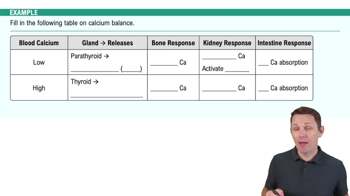
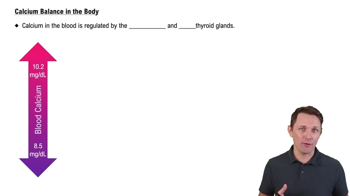
Which glands regulate blood calcium levels, and what hormones do they release?
The thyroid gland releases calcitonin when calcium is high, and the parathyroid glands release parathyroid hormone (PTH) when calcium is low.
How does calcitonin lower blood calcium levels?
Calcitonin signals bones to take up calcium, kidneys to excrete more calcium, and intestines to decrease calcium absorption.
What does parathyroid hormone (PTH) do when blood calcium is low?
PTH signals bones to release calcium, kidneys to retain calcium and activate vitamin D, which increases intestinal absorption.
What is the main function of phosphorus in the body besides bone structure?
Phosphorus is used in energy storage molecules like ATP, helps balance blood pH, and is a component of DNA, RNA, and cell membranes.
What is the RDA for phosphorus in adults?
The RDA for phosphorus in adults is 700 mg per day.
Why are phosphorus deficiencies rare in the general population?
Phosphorus is abundant in many foods, especially animal products, legumes, and seeds, making deficiencies uncommon except in starvation.
What can happen if phosphorus levels become excessively high, especially in people with kidney problems?
Excess phosphorus (hyperphosphatemia) can lead to calcification of soft tissues, but this usually occurs only if kidney function is impaired.
What is the main dietary concern regarding calcium intake in the population?
Most people do not get enough calcium, with about 30% of males and 60% of females being deficient, increasing the risk of osteoporosis.
 IndietroIndietro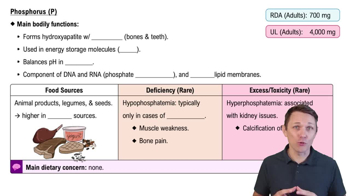
 03:35
03:35