Skip to main content
Nutrition
Il mio corso
Impara
Preparazione agli esami
AI Tutor
Guide di studio
Flashcard
Prova l'app
Il mio corso
Impara
Preparazione agli esami
AI Tutor
Guide di studio
Flashcard
Prova l'app
Indietro
Nutrient Absorption and Transport exam
Puoi toccare per girare la carta.
What is the primary site of nutrient absorption in the digestive system?
Puoi toccare per girare la carta.
👆
What is the primary site of nutrient absorption in the digestive system?
The small intestine.
Avanzamenti del tracciato
I pulsanti di controllo sono stati cambiati in modalità "navigazione".
1/26
Flashcard correlate
Pratica correlata
Video consigliati
Nutrient Absorption and Transport definitions
Nutrient Absorption and Transport
15 Termini
Nutrient Absorption and Transport quiz
Nutrient Absorption and Transport
15 Termini
Nutrient Absorption and Transport
3. The Human Body & Digestion
10 Problemi
Argomento
The Gut Microbiome
3. The Human Body & Digestion
10 Problemi
Argomento
3. The Human Body & Digestion
7 Argomenti
15 Problemi
Capitolo
04:17
Nutrient Absorption
558
views
7
rank
02:14
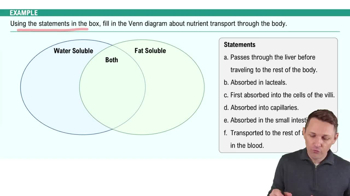
Nutrient Absorption and Transport Example 1
320
views
5
rank
03:38
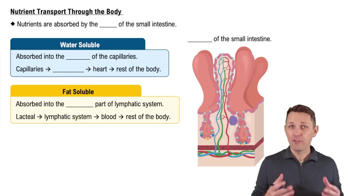
Nutrient Transport Through the Body
345
views
7
rank
Termini in questo insieme (26)
Nascondere definizioni
What is the primary site of nutrient absorption in the digestive system?
The small intestine.
Villi
Finger-like projections in the small intestine that increase surface area for nutrient absorption.
Passive diffusion
Movement of molecules from high to low concentration directly through the cell membrane without energy.
How do water-soluble nutrients enter the body after absorption?
They enter the bloodstream via capillaries in the villi.
Facilitated diffusion
Movement of molecules from high to low concentration through a protein channel or carrier protein, without energy.
Active transport
Energy-requiring process where protein pumps move nutrients against the concentration gradient.
What is the role of the hepatic portal vein?
It carries blood with absorbed nutrients from the digestive system to the liver.
Endocytosis
Process where the cell membrane engulfs nutrients, forming a vesicle to bring them into the cell.
Lacteal
A lymphatic vessel in the villi that absorbs fat-soluble nutrients.
How are fat-soluble nutrients transported after absorption?
They are absorbed into lacteals and transported via the lymphatic system before entering the bloodstream.
What is the main difference between passive and facilitated diffusion?
Passive diffusion goes directly through the membrane; facilitated diffusion uses a protein channel.
Lymphatic system
A network of vessels that transports lymph and fat-soluble nutrients throughout the body.
Why can't fat-soluble nutrients enter the blood directly?
Because they do not dissolve in water, which is the main component of blood.
Capillaries in villi
Tiny blood vessels that absorb water-soluble nutrients from the small intestine.
What happens to nutrients after they reach the liver?
They are processed, some are stored, and then distributed to the rest of the body.
Concentration gradient
A difference in the concentration of a substance across a space or membrane.
What is the function of carrier proteins in nutrient absorption?
They help transport molecules across the cell membrane, especially in facilitated diffusion and active transport.
Vesicle
A small membrane-bound sac that transports substances into or within a cell.
How do nutrients move from the gut into the cells of the intestinal wall?
Through passive diffusion, facilitated diffusion, active transport, or endocytosis.
Why is increased surface area important in the small intestine?
It allows for more efficient nutrient absorption.
Hepatic portal vein
The blood vessel that transports absorbed nutrients from the digestive tract to the liver.
What is the main fluid in the lymphatic system?
Lymph.
What type of nutrients are absorbed directly into the blood?
Water-soluble nutrients.
What is the role of the heart in nutrient transport?
It pumps blood containing nutrients to the rest of the body.
Why is energy required for active transport?
To move nutrients against their concentration gradient.
What happens to fat-soluble nutrients in the lymphatic system before entering the blood?
They may be processed or paired with carrier proteins to allow entry into the bloodstream.
 IndietroIndietro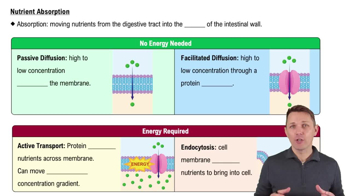
 04:17
04:17