Skip to main content
Nutrition
Il mio corso
Impara
Preparazione agli esami
AI Tutor
Guide di studio
Flashcard
Prova l'app
Il mio corso
Impara
Preparazione agli esami
AI Tutor
Guide di studio
Flashcard
Prova l'app
Indietro
Overview of the Digestive System exam
1 Lo studente ha trovato utile questo
Puoi toccare per girare la carta.
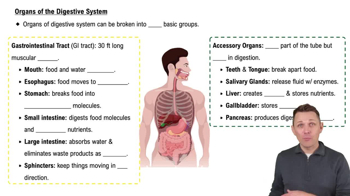
What is the gastrointestinal (GI) tract?
Puoi toccare per girare la carta.
👆
What is the gastrointestinal (GI) tract?
A 30-foot muscular tube running from the mouth to the anus, where food passes through.
Avanzamenti del tracciato
I pulsanti di controllo sono stati cambiati in modalità "navigazione".
1/26
Flashcard correlate
Pratica correlata
Video consigliati
Overview of the Digestive System definitions
Overview of the Digestive System
15 Termini
Overview of the Digestive System quiz
Overview of the Digestive System
15 Termini
Overview of the Digestive System
3. The Human Body & Digestion
10 Problemi
Argomento
Organs of the Gastrointestinal Tract
3. The Human Body & Digestion
10 Problemi
Argomento
3. The Human Body & Digestion
7 Argomenti
15 Problemi
Capitolo
02:19
Overview of the Digestive System Example 2
350
views
8
rank
06:13
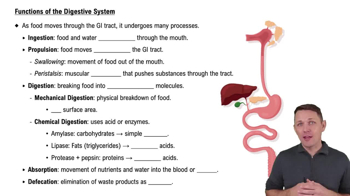
Functions of the Digestive System
456
views
9
rank
05:00
Organs of the Digestive System
606
views
11
rank
Termini in questo insieme (26)
Nascondere definizioni
What is the gastrointestinal (GI) tract?
A 30-foot muscular tube running from the mouth to the anus, where food passes through.
Accessory organs
Organs that aid digestion but are not part of the GI tract, such as the liver, pancreas, and gallbladder.
What is the main function of the small intestine?
Digestion and absorption of nutrients.
Peristalsis
A wave-like muscular contraction that propels food through the digestive tract.
What does the large intestine primarily absorb?
Water.
Mechanical digestion
The physical breakdown of food into smaller pieces to increase surface area.
What is the function of the liver in digestion?
Produces bile and processes/stores nutrients.
Chemical digestion
The breakdown of food molecules by enzymes and acids into absorbable forms.
What enzyme breaks down carbohydrates?
Amylase.
Protease
An enzyme that breaks down proteins into amino acids.
What is the role of the gallbladder?
Stores bile produced by the liver until it is needed in the small intestine.
Lipase
An enzyme that digests fats into fatty acids.
What is the function of sphincters in the digestive system?
Circular muscles that separate organs and control the direction of food movement.
Ingestion
The process of taking food and water into the mouth.
What is defecation?
The elimination of undigested waste as feces.
Salivary glands
Glands that secrete saliva containing enzymes to begin digestion in the mouth.
What is the main function of the pancreas in digestion?
Produces digestive enzymes and fluids released into the small intestine.
Absorption
The movement of nutrients and water from the digestive tract into the blood or lymph.
What is the alimentary canal?
Another term for the gastrointestinal (GI) tract.
Where does most chemical digestion occur?
In the small intestine.
Bile
A substance produced by the liver that helps digest fats.
What is the function of the mouth in digestion?
Entry point for food and water; begins mechanical and chemical digestion.
What is the main function of the esophagus?
Transports food from the mouth to the stomach.
What is the role of the stomach in digestion?
Stores food and breaks it down into digestible molecules.
What is the function of the teeth and tongue?
Break apart and manipulate food during mechanical digestion.
What is the function of pepsin?
A protease enzyme in the stomach that breaks down proteins.
 IndietroIndietro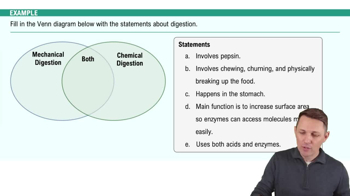
 02:19
02:19