Skip to main content
Nutrition
Il mio corso
Impara
Preparazione agli esami
AI Tutor
Guide di studio
Flashcard
Prova l'app
Il mio corso
Impara
Preparazione agli esami
AI Tutor
Guide di studio
Flashcard
Prova l'app
Indietro
Protein Synthesis exam
Puoi toccare per girare la carta.
What are the two main steps of gene expression?
Puoi toccare per girare la carta.
👆
What are the two main steps of gene expression?
Transcription and translation.
Avanzamenti del tracciato
I pulsanti di controllo sono stati cambiati in modalità "navigazione".
1/28
Flashcard correlate
Pratica correlata
Video consigliati
Protein Synthesis definitions
Protein Synthesis
15 Termini
Protein Synthesis quiz
Protein Synthesis
15 Termini
Protein Synthesis
6. Proteins
10 Problemi
Argomento
Why Do We Need Protein?
6. Proteins
10 Problemi
Argomento
6. Proteins
7 Argomenti
15 Problemi
Capitolo
VideoThumbView.guidedCourse
03:42
Epigenetics & Nutrigenomics
234
views
5
rank
VideoThumbView.guidedCourse
03:00
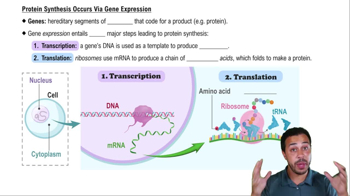
Protein Synthesis Occurs Via Gene Expression
290
views
6
rank
VideoThumbView.guidedCourse
02:45
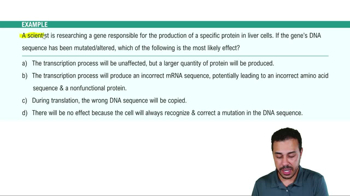
Protein Synthesis Example 1
181
views
2
rank
Termini in questo insieme (28)
Nascondere definizioni
What are the two main steps of gene expression?
Transcription and translation.
Gene
A hereditary segment of DNA that codes for a product, usually a protein.
Where does transcription occur in the cell?
In the nucleus.
Transcription
The process where DNA is used as a template to produce messenger RNA (mRNA).
What is the role of mRNA in protein synthesis?
It carries the genetic code from DNA to the ribosome for translation.
Translation
The process where ribosomes use mRNA to synthesize a chain of amino acids into a protein.
What is the function of tRNA during translation?
tRNA delivers amino acids to the ribosome.
Ribosome
A cell structure that synthesizes proteins by linking amino acids together during translation.
What determines the type and amount of proteins a cell makes?
The collection of genes and their expression.
Epigenetics
The study of chemical modifications that alter gene expression without changing the DNA sequence.
How does epigenetics affect cell differentiation?
By activating or suppressing genes, leading to different proteins being produced in different cell types.
Nutrigenomics
A branch of epigenetics that studies how diet influences gene expression.
What is the potential future application of nutrigenomics?
Personalized nutrition to reduce chronic disease risk.
What is the primary structure of a protein?
A chain of amino acids linked together.
How can the same DNA result in different cell types?
Different genes are expressed in different cells due to epigenetic modifications.
Messenger RNA (mRNA)
A type of RNA that carries genetic information from DNA to the ribosome.
What happens to mRNA after it is produced in the nucleus?
It is processed and moves to the cytoplasm for translation.
Transfer RNA (tRNA)
A type of RNA that brings amino acids to the ribosome during protein synthesis.
What is gene expression?
The process of producing the product that a gene encodes, often a protein.
How can epigenetics increase protein production?
By activating genes, leading to increased gene expression.
What is the role of ribosomes in protein synthesis?
They assemble amino acids into proteins using the sequence provided by mRNA.
How does diet potentially influence gene expression?
Through nutrigenomics, certain nutrients can modify gene expression.
What is the significance of chemical modifications in epigenetics?
They can turn genes on or off without altering the DNA sequence.
Why is nutrigenomics considered a promising field?
It may help tailor diets to individual genetic profiles to prevent disease.
What is the cytoplasm's role in protein synthesis?
It is where translation and protein assembly occur.
How do ribosomes know which amino acids to link together?
They read the sequence of codons on the mRNA.
What allows cells with identical DNA to have different functions?
Differences in gene expression regulated by epigenetics.
What is the end result of protein synthesis?
A functional protein with a specific structure and function.
 IndietroIndietro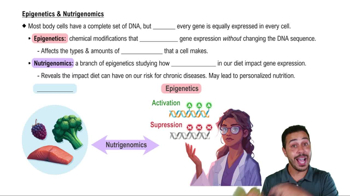
 03:42
03:42