Skip to main content
Nutrition
Il mio corso
Impara
Preparazione agli esami
AI Tutor
Guide di studio
Flashcard
Prova l'app
Il mio corso
Impara
Preparazione agli esami
AI Tutor
Guide di studio
Flashcard
Prova l'app
Indietro
Simple vs Complex Carbohydrates exam
Puoi toccare per girare la carta.
What are the two main categories of carbohydrates?
Puoi toccare per girare la carta.
👆
What are the two main categories of carbohydrates?
Simple carbohydrates (sugars) and complex carbohydrates (polysaccharides).
Avanzamenti del tracciato
I pulsanti di controllo sono stati cambiati in modalità "navigazione".
1/29
Flashcard correlate
Pratica correlata
Video consigliati
Simple vs Complex Carbohydrates definitions
Simple vs Complex Carbohydrates
15 Termini
Simple vs Complex Carbohydrates quiz
Simple vs Complex Carbohydrates
15 Termini
Simple vs Complex Carbohydrates
4. Carbohydrates
10 Problemi
Argomento
Why Do We Need Carbohydrates?
4. Carbohydrates
10 Problemi
Argomento
4. Carbohydrates
9 Argomenti
15 Problemi
Capitolo
VideoThumbView.guidedCourse
02:26
Simple vs Complex Carbohydrates Example 2
307
views
4
rank
VideoThumbView.guidedCourse
03:28
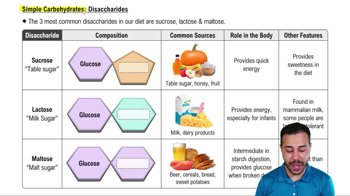
Simple Carbohydrates: Disaccharides
336
views
8
rank
VideoThumbView.guidedCourse
03:54
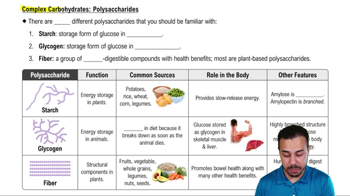
Complex Carbohydrates: Polysaccharides
382
views
9
rank
Termini in questo insieme (29)
Nascondere definizioni
What are the two main categories of carbohydrates?
Simple carbohydrates (sugars) and complex carbohydrates (polysaccharides).
Monosaccharide
A single carbohydrate (sugar) unit; examples include glucose, fructose, and galactose.
What is the primary function of glucose in the body?
It serves as the main energy source for most cells.
Disaccharide
A carbohydrate made of two monosaccharides linked together; examples are sucrose, lactose, and maltose.
Which monosaccharide is known as fruit sugar?
Fructose.
Polysaccharide
A carbohydrate consisting of many monosaccharides linked together; includes starch, glycogen, and fiber.
What is the storage form of glucose in plants?
Starch.
Sucrose
A disaccharide composed of glucose and fructose; commonly known as table sugar.
What is the main storage form of glucose in animals?
Glycogen.
Lactose
A disaccharide made of glucose and galactose; found in milk and dairy products.
What is the function of fiber in the body?
Promotes bowel health and provides other health benefits.
Maltose
A disaccharide made of two glucose units; found in beer and starchy foods.
Which carbohydrate is the sweetest among glucose, fructose, and galactose?
Fructose.
What must happen to disaccharides and polysaccharides before absorption?
They must be broken down into monosaccharides.
Amylose
A linear form of starch.
What is the branched form of starch called?
Amylopectin.
Why is glycogen highly branched?
To allow rapid release of glucose when energy is needed.
Where is glycogen stored in the human body?
In the liver and skeletal muscle.
What is lactose intolerance?
The inability to effectively digest lactose due to lack of the enzyme lactase.
Which foods are common sources of starch?
Potatoes, rice, wheat, corn, and legumes.
Galactose
A monosaccharide found in dairy products and some legumes; usually consumed as part of lactose.
What is the main role of disaccharides in the body?
To provide quick energy.
Can humans digest fiber?
No, humans lack the enzymes to digest fiber.
What is the chemical formula for glucose?
C6H12O6.
Which disaccharide is less sweet than sucrose?
Maltose.
What is the main function of polysaccharides in plants and animals?
Energy storage (starch in plants, glycogen in animals).
Which monosaccharide is most important for cellular respiration?
Glucose.
What are common sources of dietary fiber?
Fruits, vegetables, whole grains, legumes, nuts, and seeds.
What happens to fructose in the liver?
It is converted into glucose or fat.
 IndietroIndietro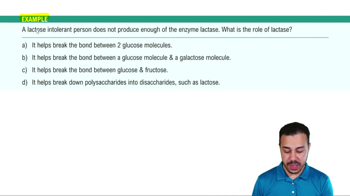
 02:26
02:26