Skip to main content
Organic Chemistry
Il mio corso
Impara
Preparazione agli esami
AI Tutor
Guide di studio
Soluzioni per libri di testo
Flashcard
Esplora
Prova l'app
Il mio corso
Impara
Preparazione agli esami
AI Tutor
Guide di studio
Soluzioni per libri di testo
Flashcard
Esplora
Prova l'app
Indietro
Addition Reactions of Furan quiz
Puoi toccare per girare la carta.
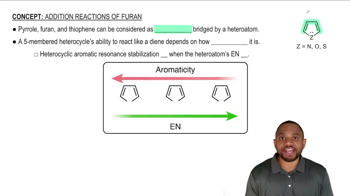
What is the relationship between aromaticity and the electronegativity of the heteroatom in five-membered heterocycles?
Puoi toccare per girare la carta.
👆
What is the relationship between aromaticity and the electronegativity of the heteroatom in five-membered heterocycles?
There is an inverse relationship; as the electronegativity of the heteroatom increases, aromaticity decreases.
Avanzamenti del tracciato
I pulsanti di controllo sono stati cambiati in modalità "navigazione".
1/15
Flashcard correlate
Pratica correlata
Video consigliati
Addition Reactions of Furan definitions
Addition Reactions of Furan
14 Termini
Addition Reactions of Furan
27. Heterocycles
5 Problemi
Argomento
EAS Reactions of Pyridine
27. Heterocycles
5 Problemi
Argomento
27. Heterocycles - Part 1 of 2
4 Argomenti
12 Problemi
Capitolo
27. Heterocycles - Part 2 of 2
4 Argomenti
12 Problemi
Capitolo
VideoThumbView.guidedCourse
2:01
Addition Reactions of Furan Example 1
508
views
VideoThumbView.guidedCourse
1:42
Addition Reactions of Furan Concept 1
502
views
VideoThumbView.guidedCourse
2:35
Addition Reactions of Furan Concept 2
483
views
Termini in questo insieme (15)
Nascondere definizioni
What is the relationship between aromaticity and the electronegativity of the heteroatom in five-membered heterocycles?
There is an inverse relationship; as the electronegativity of the heteroatom increases, aromaticity decreases.
Which heteroatom in five-membered heterocycles is the most electronegative?
Oxygen is the most electronegative heteroatom among sulfur, nitrogen, and oxygen.
How does the aromaticity of furan compare to thiophene and pyrrole?
Furan has the lowest aromaticity, while thiophene has the highest and pyrrole is intermediate.
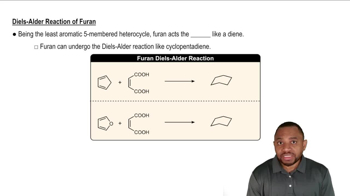
Why does furan act most like a diene among five-membered heterocycles?
Because it is the least aromatic, furan behaves more like a diene in addition reactions.
What type of reaction can furan undergo due to its diene-like behavior?
Furan can undergo Diels-Alder reactions similar to cyclopentadiene.
What is a dienophile in the context of Diels-Alder reactions?
A dienophile is an alkene or alkyne that reacts with a diene, often enhanced by electron-withdrawing groups.
What happens to the pi bonds during the Diels-Alder reaction of furan?
The pi bonds rearrange to form a new six-membered ring with specific stereochemistry.
Which product is favored in the Diels-Alder reaction of furan?
The endo product is favored, resulting in a specific arrangement of substituents.
How does the stereochemistry of the endo product manifest in the Diels-Alder reaction?
Substituents such as carboxylic acids are cis and point down, while hydrogens point up.
What structural change occurs to the oxygen atom in furan during the Diels-Alder reaction?
The oxygen bends up out of the way in the three-dimensional structure of the product.
How does the Diels-Alder reaction of furan compare to that of cyclopentadiene?
The process is similar, but furan's heteroatom (oxygen) affects the product's structure and reactivity.
What is the effect of increasing electronegativity of the heteroatom on the reactivity of five-membered heterocycles?
Increasing electronegativity decreases aromaticity, making the compound more reactive in addition reactions.
Why does thiophene react differently from furan in addition reactions?
Thiophene is more aromatic due to sulfur's lower electronegativity, making it less reactive than furan.
What is the role of resonance stability in the reactivity of heterocyclic compounds?
Lower resonance stability (less aromaticity) increases the compound's tendency to undergo addition reactions.
What is the general structure of furan and how does it relate to butadiene?
Furan is a five-membered ring with two double bonds and an oxygen atom, resembling butadiene bridged by a heteroatom.
 IndietroIndietro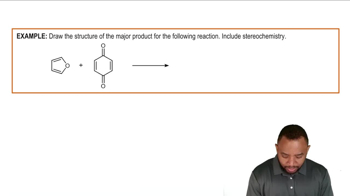
 2:01
2:01