Skip to main content
Organic Chemistry
Il mio corso
Impara
Preparazione agli esami
AI Tutor
Guide di studio
Soluzioni per libri di testo
Flashcard
Esplora
Prova l'app
Il mio corso
Impara
Preparazione agli esami
AI Tutor
Guide di studio
Soluzioni per libri di testo
Flashcard
Esplora
Prova l'app
Indietro
Amine Alkylation quiz
Puoi toccare per girare la carta.
What is the main functional group involved in amine alkylation reactions?
Puoi toccare per girare la carta.
👆
What is the main functional group involved in amine alkylation reactions?
The main functional group is the amine, which contains a nucleophilic nitrogen atom with a lone pair.
Avanzamenti del tracciato
I pulsanti di controllo sono stati cambiati in modalità "navigazione".
1/15
Flashcard correlate
Pratica correlata
Video consigliati
Amine Alkylation definitions
Amine Alkylation
15 Termini
Amine Alkylation
26. Amines
2 Problemi
Argomento
Johnny
Gabriel Synthesis
26. Amines
3 Problemi
Argomento
Johnny
23. Amines - Part 1 of 3
4 Argomenti
11 Problemi
Capitolo
Nicole
23. Amines - Part 2 of 3
5 Argomenti
13 Problemi
Capitolo
Nicole
26. Amines - Part 3 of 3
1 Argomento
3 Problemi
Capitolo
03:51
General Reaction
1982
views
15
rank
4
comments
03:46
Propose a Synthesis
1808
views
12
rank
6
comments
03:54
Mechanism
1776
views
12
rank
Termini in questo insieme (15)
Nascondere definizioni
What is the main functional group involved in amine alkylation reactions?
The main functional group is the amine, which contains a nucleophilic nitrogen atom with a lone pair.
What type of reaction mechanism is typically used for amine alkylation with alkyl halides?
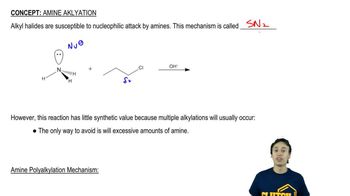
The reaction mechanism is nucleophilic substitution, specifically the SN2 mechanism.
In the SN2 mechanism for amine alkylation, what role does the amine play?
The amine acts as a nucleophile, attacking the electrophilic carbon attached to the halide.
Why are tertiary alkyl halides generally not suitable for SN2 alkylation with amines?
Tertiary alkyl halides are too sterically hindered, making it difficult for the nucleophile to access the electrophilic carbon.
What is a major problem encountered when synthesizing primary amines via alkylation with alkyl halides?
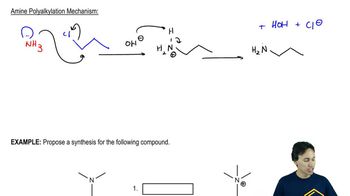
A major problem is over-alkylation, where the product amine can react further to form secondary, tertiary, or even quaternary amines.
How can the risk of polyalkylation be reduced in amine alkylation reactions?
The risk can be reduced by using an excess of amine relative to the alkyl halide.
Why is using excess amine not always a perfect solution for preventing over-alkylation?
Because it only reduces, but does not eliminate, the possibility of multiple alkyl groups attaching to the same nitrogen.
What is the final product if amine alkylation continues without excess amine present?
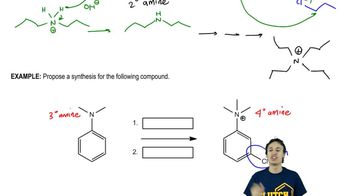
The final product is a quaternary ammonium compound, where the nitrogen is fully substituted with four alkyl groups.
What is the initial organic product formed when ammonia reacts with a primary alkyl halide in an SN2 reaction?
The initial product is a primary amine, where one hydrogen of ammonia is replaced by an alkyl group.
What happens to the nucleophilicity of the amine after the first alkylation step?
The product amine remains nucleophilic and can continue to react with more alkyl halide.
Why is amine alkylation not considered a synthetically useful method for making primary amines?
Because it often leads to polyalkylation, making it difficult to isolate the desired primary amine.
What is the leaving group in the SN2 alkylation of amines with alkyl halides?
The leaving group is the halide ion, such as Cl⁻ or Br⁻.
What is the charge on the nitrogen atom immediately after the first alkylation step before deprotonation?
The nitrogen atom has a positive charge due to the addition of an extra bond.
What is the term for the process where multiple alkyl groups are added to an amine during alkylation?
This process is called polyalkylation.
Why might alternative methods be preferred over direct amine alkylation for synthesizing primary amines?
Alternative methods are preferred because they offer more control and avoid the issue of over-alkylation.
 IndietroIndietro

 03:51
03:51