Skip to main content
Organic Chemistry
Il mio corso
Impara
Preparazione agli esami
AI Tutor
Guide di studio
Soluzioni per libri di testo
Flashcard
Esplora
Prova l'app
Il mio corso
Impara
Preparazione agli esami
AI Tutor
Guide di studio
Soluzioni per libri di testo
Flashcard
Esplora
Prova l'app
Indietro
Cleavage of Phenyl Ethers quiz
Puoi toccare per girare la carta.
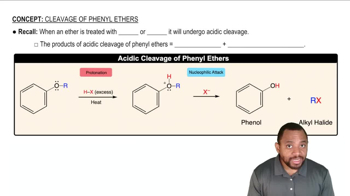
What are the products of acidic cleavage of phenyl ethers with HBr or HI?
Puoi toccare per girare la carta.
👆
What are the products of acidic cleavage of phenyl ethers with HBr or HI?
The products are phenol and an alkyl halide.
Avanzamenti del tracciato
I pulsanti di controllo sono stati cambiati in modalità "navigazione".
1/15
Flashcard correlate
Pratica correlata
Video consigliati
Cleavage of Phenyl Ethers definitions
Cleavage of Phenyl Ethers
13 Termini
Cleavage of Phenyl Ethers
20. Phenols
5 Problemi
Argomento
Kolbe-Schmidt Reaction
20. Phenols
5 Problemi
Argomento
25. Phenols
4 Argomenti
12 Problemi
Capitolo
Johnny
VideoThumbView.guidedCourse
1:45
Cleavage of Phenyl Ethers Concept 1
937
views
1
rank
VideoThumbView.guidedCourse
1:57
Cleavage of Phenyl Ethers Example 1
903
views
2
rank
Termini in questo insieme (15)
Nascondere definizioni
What are the products of acidic cleavage of phenyl ethers with HBr or HI?
The products are phenol and an alkyl halide.
Why does phenol not undergo further reaction under excess acid during phenyl ether cleavage?
Phenol is stable and resistant to further reaction, so it remains unchanged.
What is the first step in the acidic cleavage mechanism of phenyl ethers?
The oxygen atom in the ether is protonated by the acid.
Where does the nucleophilic attack occur during phenyl ether cleavage?
The nucleophile attacks the ether carbon that is not part of the benzene ring.
What happens to the bond between the oxygen and the alkyl group during cleavage?
The bond breaks, and the electrons move to the oxygen, forming phenol.
What reagent is commonly used for acidic cleavage of phenyl ethers?
HBr or HI is commonly used.
How does the cleavage of phenyl ethers differ from typical ethers?
Typical ethers can produce two alkyl halides, but phenyl ethers always yield phenol and an alkyl halide.
What is the role of the acid in the cleavage of phenyl ethers?
The acid protonates the ether oxygen, making it susceptible to nucleophilic attack.
Can phenol be converted to an alkyl halide under excess acid?
No, phenol remains unchanged due to its stability.
What is the significance of the benzene ring in phenyl ether cleavage?
The benzene ring prevents nucleophilic attack on its carbon, ensuring phenol formation.
What is always one of the products in phenyl ether cleavage regardless of acid amount?
Phenol is always produced.
What is the other product besides phenol in phenyl ether cleavage?
An alkyl halide is produced.
Why is the nucleophilic attack directed at the non-benzene ether carbon?
Because the benzene ring is resistant to nucleophilic attack.
What happens to the oxygen after it is protonated in the reaction?
It becomes more electrophilic and susceptible to nucleophilic attack.
What should you always remember when predicting products of phenyl ether cleavage?
Phenol and an alkyl halide will always be the products, regardless of excess acid.
 IndietroIndietro
 1:45
1:45