Skip to main content
Organic Chemistry
Il mio corso
Impara
Preparazione agli esami
AI Tutor
Guide di studio
Soluzioni per libri di testo
Flashcard
Esplora
Prova l'app
Il mio corso
Impara
Preparazione agli esami
AI Tutor
Guide di studio
Soluzioni per libri di testo
Flashcard
Esplora
Prova l'app
Indietro
Dehydrohalogenation definitions
Puoi toccare per girare la carta.
Dehydrohalogenation
Puoi toccare per girare la carta.
👆
Dehydrohalogenation
A reaction where a hydrogen and a halogen are removed from adjacent carbons, forming a double bond via an E2 mechanism.
Avanzamenti del tracciato
I pulsanti di controllo sono stati cambiati in modalità "navigazione".
1/13
Flashcard correlate
Pratica correlata
Video consigliati
Dehydrohalogenation quiz #1
Dehydrohalogenation
10 Termini
Dehydrohalogenation
9. Alkenes and Alkynes
2 Problemi
Argomento
Johnny
Double Elimination
9. Alkenes and Alkynes
2 Problemi
Argomento
Johnny
9. Alkenes and Alkynes - Part 1 of 2
5 Argomenti
11 Problemi
Capitolo
Ernest
9. Alkenes and Alkynes - Part 2 of 2
5 Argomenti
11 Problemi
Capitolo
Johnny
03:02
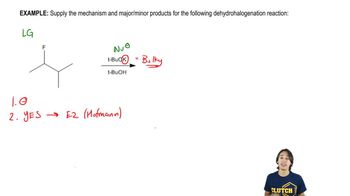
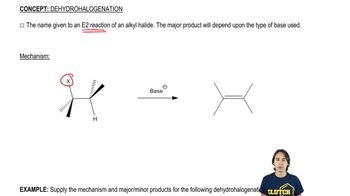
The dehydrohalogenation mechanism.
5345
views
31
rank
17
comments
04:35
Dehydrohalogenation mechanism and products
4182
views
51
rank
38
comments
Termini in questo insieme (13)
Nascondere definizioni
Dehydrohalogenation
A reaction where a hydrogen and a halogen are removed from adjacent carbons, forming a double bond via an E2 mechanism.
E2 Mechanism
A concerted elimination process where a base removes a beta hydrogen as a leaving group departs, forming a pi bond.
Alkyl Halide
A molecule containing a carbon chain bonded to a halogen, serving as the substrate for elimination.
Beta Hydrogen
A hydrogen atom attached to the carbon adjacent to the one bearing the leaving group, targeted during elimination.
Base
A species that abstracts a proton from the beta position, initiating the elimination process.
Zaitsev Product
The more substituted alkene formed preferentially when a small, strong base is used in elimination.
Hofmann Product
The less substituted alkene formed when a bulky base is used, due to steric hindrance.
Antiperiplanar Geometry
A spatial arrangement where the beta hydrogen and leaving group are on opposite sides, favoring elimination.
Leaving Group
An atom or group, often a halide, that departs with a pair of electrons during the reaction.
Conjugate Acid
The species formed when the base gains a proton during the elimination process.
Double Bond
A pi bond formed between two carbons as a result of the elimination of a hydrogen and a halogen.
Newman Projection
A visual representation used to assess the spatial orientation of substituents during elimination.
Substitution
The degree to which carbons bonded to the reactive center are replaced by other carbon groups, influencing reactivity.
 IndietroIndietro

 03:02
03:02