Skip to main content
Organic Chemistry
Il mio corso
Impara
Preparazione agli esami
AI Tutor
Guide di studio
Soluzioni per libri di testo
Flashcard
Esplora
Prova l'app
Il mio corso
Impara
Preparazione agli esami
AI Tutor
Guide di studio
Soluzioni per libri di testo
Flashcard
Esplora
Prova l'app
Indietro
Gabriel Synthesis definitions
Puoi toccare per girare la carta.
Gabriel Synthesis
Puoi toccare per girare la carta.
👆
Gabriel Synthesis
A method using potassium thalidomide to efficiently produce primary amines, avoiding polyalkylation and unwanted by-products.
Avanzamenti del tracciato
I pulsanti di controllo sono stati cambiati in modalità "navigazione".
1/15
Flashcard correlate
Pratica correlata
Video consigliati
Gabriel Synthesis quiz
Gabriel Synthesis
15 Termini
Gabriel Synthesis
26. Amines
3 Problemi
Argomento
Johnny
Amines by Reduction
26. Amines
7 Problemi
Argomento
Johnny
23. Amines - Part 1 of 3
4 Argomenti
11 Problemi
Capitolo
Nicole
23. Amines - Part 2 of 3
5 Argomenti
13 Problemi
Capitolo
Nicole
26. Amines - Part 3 of 3
1 Argomento
3 Problemi
Capitolo
05:42
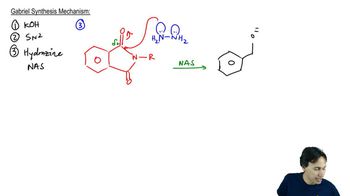
Mechanism
1772
views
21
rank
4
comments
04:53
General Reaction
1862
views
19
rank
8
comments
Termini in questo insieme (15)
Nascondere definizioni
Gabriel Synthesis
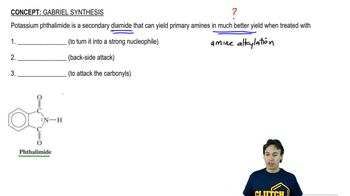
A method using potassium thalidomide to efficiently produce primary amines, avoiding polyalkylation and unwanted by-products.
Potassium Thalidomide
A secondary diamide anion formed by deprotonation, acting as a strong nucleophile in the synthesis of primary amines.
Primary Amine
A compound with a nitrogen atom bonded to one alkyl group and two hydrogens, the main product of this synthesis.
KOH
A strong base used to deprotonate thalidomide, generating the nucleophilic species needed for the reaction.
Alkyl Halide
A molecule containing a halogen attached to a primary carbon, serving as the electrophile in the SN2 step.
Hydrazine
A nucleophilic reagent (NH2NH2) that cleaves the nitrogen from thalidomide, enabling release of the primary amine.
SN2 Mechanism
A one-step nucleophilic substitution involving backside attack, leading to inversion of configuration at the electrophilic carbon.
Nucleophile
A species with a lone pair or negative charge, capable of attacking electrophilic centers in organic reactions.
Nucleophilic Acyl Substitution
A mechanism where a nucleophile replaces a leaving group on a carbonyl compound, forming a tetrahedral intermediate.
Tetrahedral Intermediate
A transient structure formed during nucleophilic attack on a carbonyl, featuring four groups attached to the central carbon.
Proton Transfer
A step where a hydrogen ion moves between atoms, often stabilizing intermediates or facilitating leaving group departure.
Polyalkylation
An undesired process where multiple alkyl groups attach to a nitrogen, leading to mixtures rather than a single primary amine.
Leaving Group
An atom or group that departs with a pair of electrons during a substitution or elimination reaction.
Carboxylic Acid Derivative
A compound structurally related to carboxylic acids, such as amides, which can undergo nucleophilic substitution.
Diamide
A molecule containing two amide groups, as seen in thalidomide, which influences its reactivity in synthesis.
 IndietroIndietro

 05:42
05:42