Skip to main content
Organic Chemistry
Il mio corso
Impara
Preparazione agli esami
AI Tutor
Guide di studio
Soluzioni per libri di testo
Flashcard
Esplora
Prova l'app
Il mio corso
Impara
Preparazione agli esami
AI Tutor
Guide di studio
Soluzioni per libri di testo
Flashcard
Esplora
Prova l'app
Indietro
Oxidation of Phenols to Quinones quiz
Puoi toccare per girare la carta.
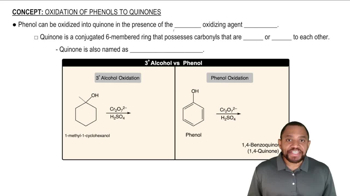
What strong oxidizing agent is commonly used to oxidize phenol to quinone?
Puoi toccare per girare la carta.
👆
What strong oxidizing agent is commonly used to oxidize phenol to quinone?
Dichromate (Cr2O7^2-) is commonly used to oxidize phenol to quinone.
Avanzamenti del tracciato
I pulsanti di controllo sono stati cambiati in modalità "navigazione".
1/15
Flashcard correlate
Pratica correlata
Video consigliati
Oxidation of Phenols to Quinones definitions
Oxidation of Phenols to Quinones
14 Termini
Oxidation of Phenols to Quinones
20. Phenols
5 Problemi
Argomento
Cleavage of Phenyl Ethers
20. Phenols
5 Problemi
Argomento
25. Phenols
4 Argomenti
12 Problemi
Capitolo
Johnny
VideoThumbView.guidedCourse
1:57
Oxidation of Phenols to Quinones Concept 2
627
views
VideoThumbView.guidedCourse
1:47
Oxidation of Phenols to Quinones Concept 1
730
views
1
rank
VideoThumbView.guidedCourse
3:00
Oxidation of Phenols to Quinones Example 1
645
views
Termini in questo insieme (15)
Nascondere definizioni
What strong oxidizing agent is commonly used to oxidize phenol to quinone?
Dichromate (Cr2O7^2-) is commonly used to oxidize phenol to quinone.
What is the structural feature of quinone regarding its carbonyl groups?
Quinone has carbonyl groups positioned either 1,2 or 1,4 to each other on a conjugated 6-membered ring.
What is another name for quinone based on its structure?
Quinone is also called cyclohexadienedione, indicating a 6-carbon ring with two double bonds and two carbonyls.
Why do tertiary alcohols not undergo oxidation?
Tertiary alcohols lack alpha hydrogens, so oxidation does not occur and results in no reaction.
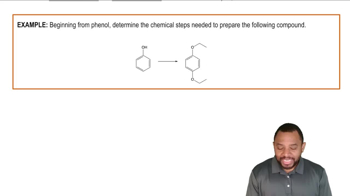
What is the product formed when phenol is oxidized with dichromate?
The product is 1,4-benzoquinone, also known as 1,4-quinone.
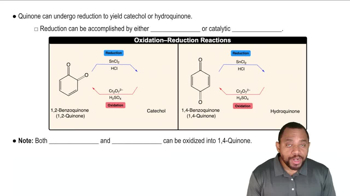
How can quinone be reduced to catechol?
Quinone can be reduced to catechol using Tin(II) chloride with hydrochloric acid or catalytic hydrogenation.
What is the structure of catechol?
Catechol is a benzene ring with two hydroxyl groups adjacent to each other (1,2 positions).
How is hydroquinone formed from quinone?
Hydroquinone is formed by reducing 1,4-quinone, resulting in hydroxyl groups at the 1,4 positions.
What are the typical metal catalysts used in catalytic hydrogenation for quinone reduction?
Nickel, palladium, or platinum are commonly used as metal catalysts in catalytic hydrogenation.
Can catechol be oxidized back to quinone?
Yes, catechol can be oxidized back to quinone.
What is the relationship between phenol, hydroquinone, and 1,4-quinone in terms of oxidation?
Both phenol and hydroquinone can be oxidized to 1,4-quinone.
What is the main difference between catechol and hydroquinone?
Catechol has hydroxyl groups at the 1,2 positions, while hydroquinone has them at the 1,4 positions on the benzene ring.
What type of reactions allow interconversion between phenol, quinone, catechol, and hydroquinone?
Oxidation and reduction reactions allow interconversion between these compounds.
What is the general structure of quinone in terms of conjugation?
Quinone is a conjugated ring with alternating double and single bonds, two carbonyls, and two double bonds.
What is the significance of alpha hydrogens in alcohol oxidation?
Alpha hydrogens are necessary for alcohol oxidation; their absence in tertiary alcohols prevents oxidation.
 IndietroIndietro
 1:57
1:57