Skip to main content
Organic Chemistry
Il mio corso
Impara
Preparazione agli esami
AI Tutor
Guide di studio
Soluzioni per libri di testo
Flashcard
Esplora
Prova l'app
Il mio corso
Impara
Preparazione agli esami
AI Tutor
Guide di studio
Soluzioni per libri di testo
Flashcard
Esplora
Prova l'app
Indietro
Reductive Amination quiz
Puoi toccare per girare la carta.
What functional group is formed when a ketone or aldehyde reacts with a primary amine in an acidic environment?
Puoi toccare per girare la carta.
👆
What functional group is formed when a ketone or aldehyde reacts with a primary amine in an acidic environment?
An imine is formed when a ketone or aldehyde reacts with a primary amine in an acidic environment.
Avanzamenti del tracciato
I pulsanti di controllo sono stati cambiati in modalità "navigazione".
1/15
Flashcard correlate
Pratica correlata
Video consigliati
Reductive Amination definitions
Reductive Amination
13 Termini
Reductive Amination
26. Amines
3 Problemi
Argomento
Ernest
Curtius Rearrangement
26. Amines
5 Problemi
Argomento
23. Amines - Part 1 of 3
4 Argomenti
11 Problemi
Capitolo
Nicole
23. Amines - Part 2 of 3
5 Argomenti
13 Problemi
Capitolo
Nicole
26. Amines - Part 3 of 3
1 Argomento
3 Problemi
Capitolo
07:12
Reductive Amination
2382
views
11
rank
2
comments
03:07
Provide the Major Product
2346
views
17
rank
6
comments
Termini in questo insieme (15)
Nascondere definizioni
What functional group is formed when a ketone or aldehyde reacts with a primary amine in an acidic environment?
An imine is formed when a ketone or aldehyde reacts with a primary amine in an acidic environment.
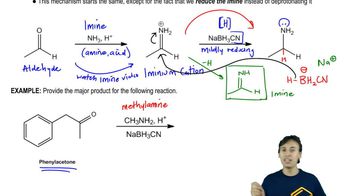
What is the key intermediate called in the imine formation mechanism?
The key intermediate is called the iminium cation, where the nitrogen has a positive charge.
What reducing agent is commonly used in reductive amination?
Sodium cyanoborohydride (NaBH3CN) is commonly used as the reducing agent in reductive amination.
Why is NaBH3CN considered a mildly reducing agent?
NaBH3CN is mildly reducing because the cyanide group is electron-withdrawing, making the reducing agent less reactive.
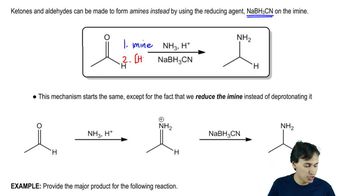
What is the final product of reductive amination when starting with a ketone or aldehyde and a primary amine?
The final product is a primary amine.
What happens to the double bond in the imine during reductive amination?
The double bond is reduced to a single bond, converting the imine into an amine.
What is the role of the reducing agent in reductive amination?
The reducing agent adds hydrogen to the imine, reducing it to an amine.
Why is it important that NaBH3CN is only mildly reducing in this reaction?
Its mild nature prevents unwanted byproducts and selectively reduces the imine without affecting other functional groups.
What is the difference between an imine and an enamine?
An imine has a double bond between carbon and nitrogen, while an enamine has the double bond between carbon atoms adjacent to the nitrogen.
What is the first step in the reductive amination mechanism?
The first step is the formation of an imine from a carbonyl compound and a primary amine in acid.
What happens if you deprotonate the iminium cation instead of reducing it?
Deprotonation of the iminium cation yields an imine.
How does the hydrogen from NaBH3CN interact with the iminium cation?
The hydrogen attacks the carbon of the iminium cation, pushing electrons up to the nitrogen and forming an amine.
What is the charge on the nitrogen in the iminium cation intermediate?
The nitrogen in the iminium cation has a positive charge.
Why is sodium present in NaBH3CN, and what happens to it during the reaction?
Sodium acts as a counterion to balance the negative charge on boron and is released into solution during the reaction.
What is the main advantage of using reductive amination in organic synthesis?
Reductive amination is a convenient way to synthesize amines from carbonyl compounds and amines in one sequence.
 IndietroIndietro

 07:12
07:12