 Indietro
Aromatic Compounds in Organic Chemistry
 08:19
08:19
Termini in questo insieme (20)
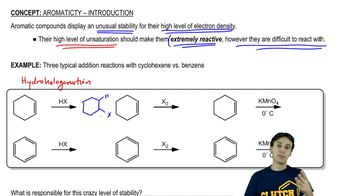
Aromatic compounds contain six-membered benzene-like rings with three double bonds, exhibiting unique stability and reactivity.
They mainly come from coal and petroleum. Coal tar distillation yields benzene, toluene, xylene, naphthalene, and other aromatics.
Named systematically with -benzene as the parent, e.g., bromobenzene (C6H5Br), nitrobenzene (C6H5NO2), propylbenzene (C6H5CH2CH2CH3).
If alkyl substituent has ≤6 carbons, it's an alkyl-substituted benzene. If ≥7 carbons, it's a phenyl-substituted alkane.
Phenyl (Ph or ɸ) is the C6H5 substituent; benzyl is the C6H5CH2- group.
Ortho (o): substituents at 1,2 positions; meta (m): 1,3 positions; para (p): 1,4 positions on the benzene ring.
A molecule is aromatic if it is planar, monocyclic, conjugated, and has \(4n+2\) π electrons, where n is an integer.
Compounds with \(4n\) π electrons (e.g., 4, 8, 12) that are planar and conjugated but less stable than aromatic compounds.
Cyclic compounds containing atoms of two or more elements in the ring, usually carbon plus nitrogen, oxygen, or sulfur.
Electrophile (E+) replaces a hydrogen on the aromatic ring, characteristic of aromatic compounds.
Electrophiles accept electron pairs (electron-poor), while nucleophiles donate electron pairs (electron-rich).
Halogenation, nitration, sulfonation, hydroxylation, acylation, and alkylation of aromatic rings.
Requires an aromatic ring and an alkyl halide with \(AlCl_3\) catalyst; primary alkyl halides undergo carbocation rearrangement.
Substituents can be activators or deactivators, directing electrophilic substitution to ortho/para or meta positions.
Electron-donating groups (e.g., -OH, -CH3) activate the ring and direct substitution to ortho and para positions.
Electron-withdrawing groups (e.g., -NO2, -COOH) deactivate the ring and direct substitution to the meta position.
Generally non-polar, immiscible with water, miscible with organic solvents, mostly colorless liquids or solids with characteristic aromas.
Typically less dense than water (0.8–0.9 g/mL), so they float on water surfaces.
Aromatic compounds burn with a sooty flame, unlike aliphatic compounds which give a yellow flame.
Side chains on aromatic rings can be oxidized (e.g., with \(KMnO_4\)) to carboxylic acids regardless of chain length.