Skip to main content
Organic Chemistry
Il mio corso
Impara
Preparazione agli esami
AI Tutor
Guide di studio
Soluzioni per libri di testo
Flashcard
Esplora
Prova l'app
Il mio corso
Impara
Preparazione agli esami
AI Tutor
Guide di studio
Soluzioni per libri di testo
Flashcard
Esplora
Prova l'app
Indietro
Haloform Reaction in Organic Chemistry
Puoi toccare per girare la carta.
What is the haloform reaction?
Puoi toccare per girare la carta.
👆
What is the haloform reaction?
A chemical reaction where a methyl ketone is halogenated at the alpha position and then cleaved to form a haloform (CHX3) and a carboxylate.
Avanzamenti del tracciato
I pulsanti di controllo sono stati cambiati in modalità "navigazione".
1/20
Video consigliati
03:50
Haloform Reaction
2144
views
17
rank
15
comments
Termini in questo insieme (20)
Nascondere definizioni
What is the haloform reaction?
A chemical reaction where a methyl ketone is halogenated at the alpha position and then cleaved to form a haloform (CHX3) and a carboxylate.
Which functional group is required for the haloform reaction?
A methyl ketone group, which has the structure \(R-CO-CH_3\).
What are the typical halogens used in the haloform reaction?
Chlorine (Cl2), bromine (Br2), or iodine (I2) are commonly used halogens.
What is the product called when iodine is used in the haloform reaction?
The product is called iodoform (CHI3).
What are the main products of the haloform reaction?
A haloform (CHX3) and a carboxylate ion (RCOO-).
What is the role of base in the haloform reaction?
The base deprotonates the alpha hydrogen and facilitates halogenation and cleavage steps.
Why is the haloform reaction useful in organic chemistry?
It is used to identify methyl ketones and to prepare haloforms.
What is the general mechanism step after alpha halogenation in the haloform reaction?
Multiple halogenations occur at the methyl group until all three hydrogens are replaced by halogens.
What happens after the methyl group is fully halogenated in the haloform reaction?
The trihalogenated methyl group is cleaved off as a haloform, leaving a carboxylate.
Can aldehydes undergo the haloform reaction?
Only aldehydes with a methyl group adjacent to the carbonyl (methyl ketone structure) can undergo the haloform reaction.
What is the color change observed in the iodoform test?
A yellow precipitate of iodoform (CHI3) forms.
What is the significance of the haloform reaction in qualitative analysis?
It serves as a test to detect the presence of methyl ketones or ethanol.
What is the chemical formula of chloroform produced in the haloform reaction?
CHCl3.
What conditions favor the haloform reaction?
Basic conditions with halogen and a methyl ketone substrate.
What is the first step in the haloform reaction mechanism?
Enolate ion formation by deprotonation of the alpha hydrogen.
How many halogen atoms replace the hydrogens on the methyl group in the haloform reaction?
Three halogen atoms replace all three hydrogens.
What happens to the carboxylate formed in the haloform reaction under acidic workup?
It is protonated to form the corresponding carboxylic acid.
Is the haloform reaction specific to methyl ketones only?
Yes, it specifically requires a methyl ketone or related structure.
What is the role of the enolate ion in the haloform reaction?
It acts as a nucleophile attacking the halogen to form alpha-halogenated intermediates.
Name a common laboratory use of the haloform reaction.
To test for the presence of acetyl groups or ethanol in a sample.
 IndietroIndietro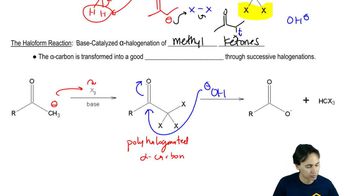
 03:50
03:50