 Indietro
Organic Chemistry: Acids and Bases
 07:46
07:46
Termini in questo insieme (27)
An Arrhenius acid increases the concentration of \(\mathrm{H^+}\) ions in aqueous solution.
An Arrhenius base increases the concentration of \(\mathrm{OH^-}\) ions in aqueous solution.
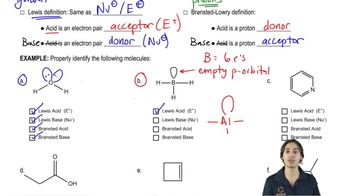
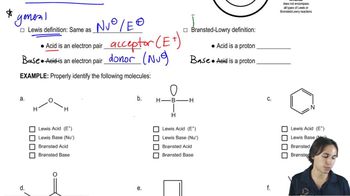
An acid is a proton donor, and a base is a proton acceptor.
A Lewis acid accepts an electron pair, and a Lewis base donates an electron pair.
Lewis bases usually have a lone pair of electrons available to donate.
Arrows start at electron pairs and show their movement to form or break bonds during acid-base reactions.
The smaller the pKa, the stronger the acid (more likely to lose a proton).
\(\mathrm{p}K_a = \mathrm{pH} + \log \frac{[HA]}{[A^-]} \) relates pKa, pH, and the ratio of acid/base forms.
If pH < pKa, species exists mainly as the acidic form; if pH > pKa, mainly as the basic form.
Electronegativity, atomic size, hybridization, inductive effects, and resonance affect acid strength.
Higher electronegativity of the atom bonded to hydrogen increases acid strength by stabilizing the conjugate base.
Larger atoms bonded to hydrogen increase acid strength by better charge distribution in the conjugate base.
More s character (e.g., sp vs sp3) increases acidity by holding electrons closer and stabilizing the conjugate base.
Electron-withdrawing groups near acidic hydrogens increase acid strength by stabilizing the conjugate base.
Resonance delocalization of the conjugate base's negative charge increases acid strength.
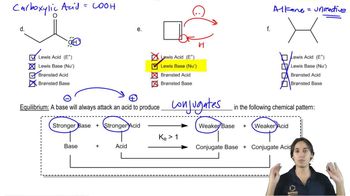
Carboxylic acids have pKa values around 3-5 and contain the -COOH group.
Alcohols have pKa values around 15-16 and contain the -OH group.
Amines are weak acids with pKa values around 30-40 and are common organic bases.
Removing a proton from an acid forms its conjugate base; adding a proton to a base forms its conjugate acid.
The stronger the acid, the weaker its conjugate base.
The conjugate base of \(\mathrm{HSO_4^-}\) is \(\mathrm{SO_4^{2-}}\).
The conjugate acid of \(\mathrm{HCO_3^-}\) is \(\mathrm{H_2CO_3}\).
Protonated compounds are usually stronger acids than their non-protonated forms.
Extract benzoic acid into aqueous base to form its salt, leaving anisole in organic layer.
Acetate ion is stabilized by resonance, unlike ethoxide ion.
Acidity increases with electronegativity: \(\mathrm{H-CH_3} < H-NH_2 < H-OH < H-F}\).
Acidity increases down the group: \(\mathrm{HF < HCl < HBr < HI}\).