



Ch. 11 - Organometallic Compounds
Bruice - Organic Chemistry 8th Edition
Bruice8th EditionOrganic ChemistryISBN: 9780135213711Non è quello che usi tu?Cambia libro di testo
Capitolo 11, Problema 57a(6)

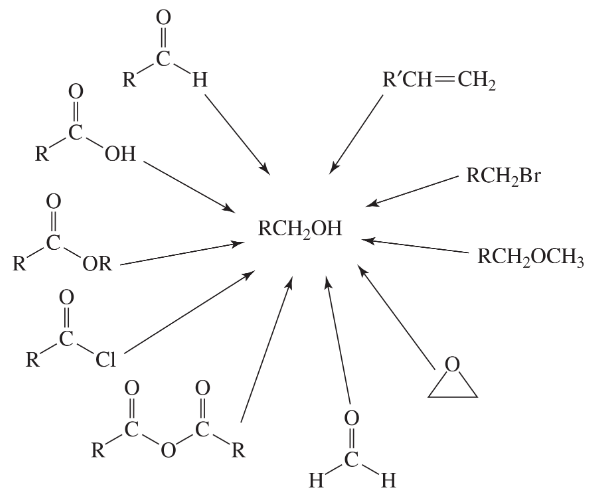
a. Show the reagents required to form the primary alcohol in each of the following reactions.

Guida verificata passo dopo passo
1
Step 1: Identify the starting material and the product. The starting material is an aldehyde (ethanal, CH₃CHO), and the product is a primary alcohol (ethanol, CH₃CH₂OH).
Step 2: Recognize the type of reaction. This is a reduction reaction where the aldehyde is reduced to a primary alcohol.
Step 3: Select the appropriate reducing agent. Common reducing agents for this transformation include sodium borohydride (NaBH₄) or lithium aluminum hydride (LiAlH₄).
Step 4: Consider the reaction conditions. NaBH₄ is typically used in protic solvents like ethanol or water, while LiAlH₄ requires anhydrous conditions and is often used in ether solvents such as diethyl ether.
Step 5: Write the reaction mechanism. The reducing agent donates hydride ions (H⁻) to the carbonyl carbon of the aldehyde, breaking the C=O double bond and forming the primary alcohol.

Risposta video verificata per un problema simile:

Questa soluzione video è stata consigliata dai nostri tutor come utile per risolvere questo problema.
Durata del video:
4m

Concetti chiave

Ecco i concetti essenziali che devi comprendere per rispondere correttamente alla domanda.

Carbonyl Compounds

Carbonyl compounds contain a carbon atom double-bonded to an oxygen atom (C=O). They are classified into aldehydes and ketones, depending on the carbonyl's position in the molecule. Aldehydes, like the one shown in the reaction, have at least one hydrogen atom attached to the carbonyl carbon, making them more reactive in nucleophilic addition reactions.
Video consigliato:
01:40
Defining meso compounds.

Nucleophilic Addition

Nucleophilic addition is a fundamental reaction mechanism in organic chemistry where a nucleophile attacks an electrophilic carbon atom, such as that in a carbonyl group. This reaction typically leads to the formation of alcohols when the carbonyl compound is reduced. In the context of the question, a nucleophile will add to the carbonyl carbon, resulting in the formation of a primary alcohol.
Video consigliato:
08:27
Nucleophilic Addition

Reagents for Alcohol Formation

To convert a carbonyl compound into a primary alcohol, specific reagents are required. Commonly, lithium aluminum hydride (LiAlH4) or sodium borohydride (NaBH4) are used as reducing agents. These reagents donate hydride ions (H-) to the carbonyl carbon, effectively reducing it and resulting in the formation of a primary alcohol.
Video consigliato:
01:52
Reagents