Ch. 11 - Organometallic Compounds
Bruice - Organic Chemistry 8th Edition
Bruice8th EditionOrganic ChemistryISBN: 9780135213711Non è quello che usi tu?Cambia libro di testo
Capitolo 11, Problema 37b

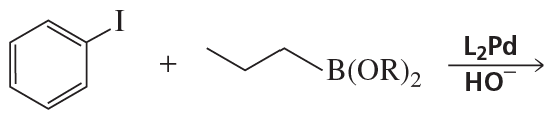
What are the products of the following reactions?
b. Chemical reaction diagram showing a phenyl iodide and a boronic ester with palladium catalyst and hydroxide.

Guida verificata passo dopo passo
1
Step 1: Recognize the reaction type. This is a Suzuki coupling reaction, which is a palladium-catalyzed cross-coupling reaction between an aryl or vinyl halide and an organoboron compound.
Step 2: Identify the reactants. The first reactant is a brominated aromatic ketone (4-bromoacetophenone), and the second reactant is a cyclohexylboronic ester.
Step 3: Understand the role of the catalyst and base. Pd(PPh₃)₄ is the palladium catalyst, which facilitates the coupling reaction, and Na₂CO₃ acts as a base to activate the boronic ester.
Step 4: Predict the bond formation. The Suzuki reaction forms a new carbon-carbon bond between the carbon attached to the bromine atom in the aryl halide and the carbon attached to the boron atom in the boronic ester.
Step 5: Write the product structure. The product will be a substituted aromatic ketone where the bromine atom is replaced by the cyclohexyl group, resulting in 4-cyclohexylacetophenone.

Risposta video verificata per un problema simile:

Questa soluzione video è stata consigliata dai nostri tutor come utile per risolvere questo problema.
Durata del video:
1m

Concetti chiave

Ecco i concetti essenziali che devi comprendere per rispondere correttamente alla domanda.

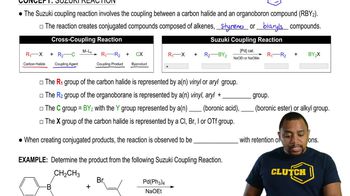
Suzuki Coupling Reaction

The Suzuki coupling reaction is a widely used method in organic chemistry for forming carbon-carbon bonds. It involves the reaction of an organoboron compound with an organic halide in the presence of a palladium catalyst and a base. This reaction is particularly valuable for synthesizing biaryl compounds and other complex organic molecules, making it essential for various applications in pharmaceuticals and materials science.
Video consigliato:
04:02
Suzuki Reaction

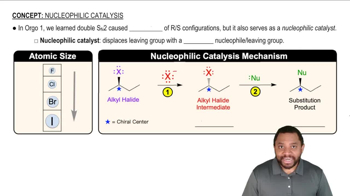
Palladium Catalysis

Palladium catalysis is a key component in many cross-coupling reactions, including the Suzuki reaction. Palladium serves as a catalyst that facilitates the transfer of the organic group from the organoboron compound to the organic halide. The use of palladium allows for milder reaction conditions and higher selectivity, which is crucial for synthesizing complex organic structures efficiently.
Video consigliato:
Percorso guidato
2:31
Nucleophilic Catalysis Concept 1

Base in Organic Reactions

In organic reactions, a base is often required to deprotonate the organoboron compound, generating a more reactive species that can participate in the coupling process. In the Suzuki reaction, sodium carbonate (Na2CO3) is commonly used as a base to facilitate the reaction. The choice of base can significantly influence the reaction's efficiency and the yield of the desired product.
Video consigliato:
02:43
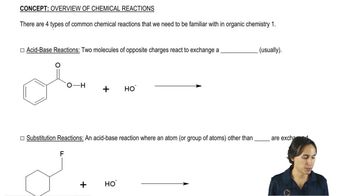
Recognizing Acid-Base Reactions.