Ch. 11 - Organometallic Compounds
Bruice - Organic Chemistry 8th Edition
Bruice8th EditionOrganic ChemistryISBN: 9780135213711Non è quello che usi tu?Cambia libro di testo
Capitolo 11, Problema 27d

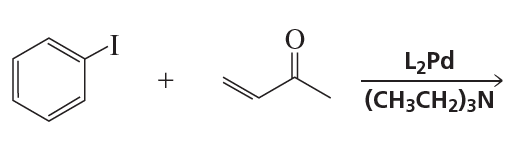
What are the products of the following reactions?
d. Chemical reaction diagram showing reactants and catalyst for the Heck reaction, with products indicated.

Guida verificata passo dopo passo
1
Step 1: Identify the reaction type. This is a Heck reaction, which is a palladium-catalyzed coupling reaction between an aryl halide (or vinyl halide) and an alkene.
Step 2: Analyze the reactants. The aryl halide is bromostyrene (C6H5-CH=CH-Br), and the alkene is methyl vinyl ketone (CH2=CH-C(O)-CH(CH3)2). The palladium catalyst (L2Pd) and triethylamine ((CH3CH2)3N) are used to facilitate the reaction.
Step 3: Determine the regioselectivity. In the Heck reaction, the alkene typically undergoes substitution at the less sterically hindered position, forming a new C-C bond between the aryl group and the alkene.
Step 4: Predict the product structure. The bromostyrene will couple with the methyl vinyl ketone at the terminal carbon of the alkene, resulting in a substituted alkene product. The double bond in the product will shift to the internal position due to the reaction mechanism.
Step 5: Verify stereochemistry. The Heck reaction often produces the E-isomer of the product due to steric and electronic factors. Ensure the final product reflects this stereochemical preference.

Risposta video verificata per un problema simile:

Questa soluzione video è stata consigliata dai nostri tutor come utile per risolvere questo problema.
Durata del video:
3m

Concetti chiave

Ecco i concetti essenziali che devi comprendere per rispondere correttamente alla domanda.

Heck Reaction

The Heck reaction is a palladium-catalyzed coupling reaction between an aryl or vinyl halide and an alkene, resulting in the formation of substituted alkenes. This reaction is significant in organic synthesis for constructing complex molecules and is widely used in the pharmaceutical and materials industries. The reaction typically requires a base and a ligand to stabilize the palladium catalyst.
Video consigliato:
05:09
Heck Reaction

Palladium Catalysis

Palladium catalysis is a key component in many cross-coupling reactions, including the Heck reaction. Palladium serves as a transition metal catalyst that facilitates the formation of carbon-carbon bonds by enabling the oxidative addition of the halide and the subsequent reductive elimination of the product. The choice of ligands and reaction conditions can significantly influence the efficiency and selectivity of the reaction.
Video consigliato:
Percorso guidato
2:31
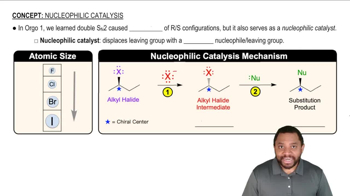
Nucleophilic Catalysis Concept 1

Substitution and Addition Reactions

Substitution and addition reactions are fundamental types of organic reactions. In the context of the Heck reaction, the aryl halide undergoes substitution where the halogen is replaced by the alkene, leading to the formation of a new carbon-carbon bond. Understanding these mechanisms is crucial for predicting the products of reactions and designing synthetic pathways in organic chemistry.
Video consigliato:
Percorso guidato
1:42
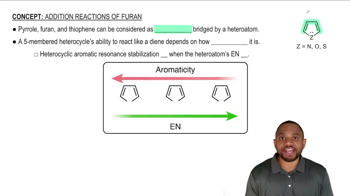
Addition Reactions of Furan Concept 1