Ch. 11 - Organometallic Compounds
Bruice - Organic Chemistry 8th Edition
Bruice8th EditionOrganic ChemistryISBN: 9780135213711Non è quello che usi tu?Cambia libro di testo
Capitolo 11, Problema 33a,b

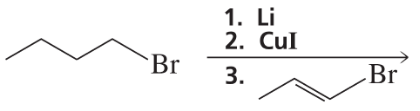
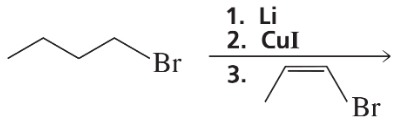
What are the products of the following reactions?
a.
b.

Guida verificata passo dopo passo
1
Step 1: Analyze the starting material, which is an alkyl bromide (CH3CH2CH2Br). This compound contains a bromine atom attached to a propyl chain.
Step 2: The first reagent, lithium (Li), reacts with the alkyl bromide to form an organolithium compound (CH3CH2CH2Li). This is a nucleophilic species formed by replacing the bromine atom with lithium.
Step 3: The second reagent, copper(I) iodide (CuI), reacts with the organolithium compound to form a Gilman reagent (CH3CH2CH2)2CuLi. Gilman reagents are useful for coupling reactions.
Step 4: The third step involves the reaction of the Gilman reagent with the alkyl bromide provided in the reaction scheme (CH2=CHCH2Br or CH2=CHCHBrCH3). This is a coupling reaction where the Gilman reagent replaces the bromine atom in the alkyl bromide with the alkyl group from the Gilman reagent.
Step 5: The final product is formed by combining the alkyl group from the Gilman reagent with the alkyl bromide, resulting in a new carbon-carbon bond. The specific product depends on the structure of the alkyl bromide used in the third step.

Risposta video verificata per un problema simile:

Questa soluzione video è stata consigliata dai nostri tutor come utile per risolvere questo problema.
Durata del video:
5m

Concetti chiave

Ecco i concetti essenziali che devi comprendere per rispondere correttamente alla domanda.

Organolithium Reagents

Organolithium reagents, such as those formed from lithium and organic halides, are highly reactive compounds used in organic synthesis. They act as strong nucleophiles, facilitating the formation of carbon-carbon bonds by attacking electrophiles. In the given reaction, lithium likely helps to generate a lithium alkyl intermediate that can further react with copper(I) iodide.
Video consigliato:
01:52
Reagents

Cuprate Reagents

Cuprate reagents, formed from the reaction of organolithium compounds with copper(I) halides, are important in organic synthesis for their ability to participate in nucleophilic substitutions. They can react with alkyl halides to form new carbon-carbon bonds, allowing for the construction of more complex molecules. The use of CuI in the reaction indicates a pathway to generate a new alkyl group.
Video consigliato:
01:52
Reagents

Nucleophilic Substitution Reactions

Nucleophilic substitution reactions involve the replacement of a leaving group (like bromine) by a nucleophile. In this context, the organolithium and cuprate reagents act as nucleophiles that attack the carbon atom bonded to the bromine, leading to the formation of new carbon-carbon bonds. Understanding the mechanism of these reactions is crucial for predicting the products of the given transformations.
Video consigliato:
01:47
Nucleophiles and Electrophiles can react in Substitution Reactions.