Ch. 13 - Mass Spectrometry; Infrared Spectroscopy; UV/Vis Spectroscopy
Bruice - Organic Chemistry 8th Edition
Bruice8th EditionOrganic ChemistryISBN: 9780135213711Non è quello che usi tu?Cambia libro di testo
Capitolo 13, Problema 17d

Using curved arrows, show the principal fragments you would expect to see in the mass spectrum of each of the following compounds:
d.

Guida verificata passo dopo passo
1
Identify the compound provided in the problem. If the compound is not explicitly stated, assume it is a generic organic molecule. The goal is to determine the principal fragments formed during mass spectrometry analysis.
Recall that in mass spectrometry, the molecule is ionized (usually by electron impact), leading to the formation of a molecular ion (M⁺). This ion can then fragment into smaller ions and neutral species. Use curved arrows to represent the movement of electrons during bond cleavage.
Analyze the structure of the compound to identify the most likely bonds to break. Bonds adjacent to functional groups, or those that lead to the formation of stable carbocations (e.g., tertiary carbocations, allylic carbocations, or benzyl carbocations), are more likely to break.
Draw the molecular ion (M⁺) and use curved arrows to show the electron movement that leads to the formation of the first principal fragment. For example, if a bond breaks to form a carbocation and a neutral radical, indicate this with curved arrows starting from the bond and pointing toward the atoms involved.
Repeat the process for other possible fragmentations, focusing on those that produce stable ions. Label each fragment with its corresponding m/z value (mass-to-charge ratio) based on the molecular weights of the fragments. Ensure that the fragments are consistent with the rules of mass spectrometry.

Risposta video verificata per un problema simile:

Questa soluzione video è stata consigliata dai nostri tutor come utile per risolvere questo problema.
Durata del video:
4m

Concetti chiave

Ecco i concetti essenziali che devi comprendere per rispondere correttamente alla domanda.

Mass Spectrometry

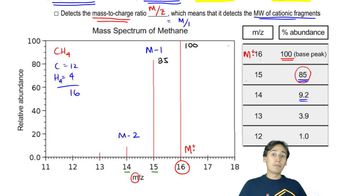
Mass spectrometry is an analytical technique used to measure the mass-to-charge ratio of ions. It involves ionizing chemical species and sorting the ions based on their mass. The resulting mass spectrum provides information about the molecular weight and structure of the compounds, allowing chemists to identify fragments produced during ionization.
Video consigliato:
01:25
How to Read a Mass Spectrum

Fragmentation Patterns

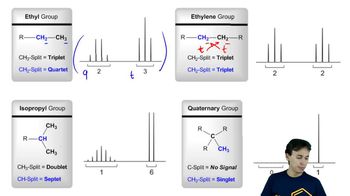
Fragmentation patterns refer to the specific ways in which a molecule breaks apart during ionization in mass spectrometry. These patterns are influenced by the molecular structure and stability of the resulting fragments. Understanding common fragmentation pathways helps predict the principal fragments that will appear in the mass spectrum of a compound.
Video consigliato:
08:06
Common Splitting Patterns

Curved Arrows in Mechanisms

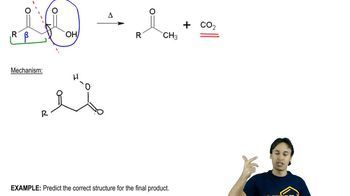
Curved arrows are used in organic chemistry to illustrate the movement of electrons during chemical reactions, particularly in mechanisms. They indicate the direction of electron flow, helping to visualize how bonds are formed or broken. In the context of mass spectrometry, curved arrows can be used to depict the fragmentation process, showing how a molecule dissociates into smaller ions.
Video consigliato:
04:32
General Mechanism