Ch. 14 - NMR Spectroscopy
Bruice - Organic Chemistry 8th Edition
Bruice8th EditionOrganic ChemistryISBN: 9780135213711Non è quello che usi tu?Cambia libro di testo
Capitolo 14, Problema 47b(2)

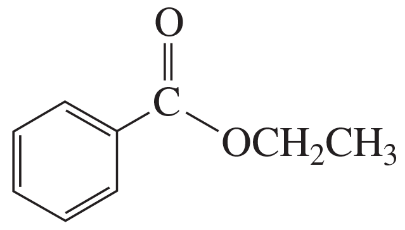
How many signals are produced by each of the following compounds in its
b. 13C NMR spectrum?
2.

Guida verificata passo dopo passo
1
Analyze the structure of the compound. The molecule consists of a benzene ring with a methyl group attached to one position, a ketone group attached to another position, and an ethoxy group attached to the ketone.
Determine the symmetry of the benzene ring. The methyl group creates asymmetry, meaning the carbons in the benzene ring are not equivalent. Each carbon in the benzene ring will produce a unique signal in the 13C NMR spectrum.
Consider the methyl group attached to the benzene ring. The carbon in the methyl group is unique and will produce its own signal.
Examine the ketone group. The carbonyl carbon (C=O) is distinct and will produce a separate signal in the 13C NMR spectrum.
Analyze the ethoxy group. The ethoxy group contains two unique carbons: the carbon directly attached to the oxygen and the terminal carbon in the ethyl chain. Each of these carbons will produce separate signals in the 13C NMR spectrum.

Risposta video verificata per un problema simile:

Questa soluzione video è stata consigliata dai nostri tutor come utile per risolvere questo problema.
Durata del video:
3m

Concetti chiave

Ecco i concetti essenziali che devi comprendere per rispondere correttamente alla domanda.

Nuclear Magnetic Resonance (NMR) Spectroscopy

NMR spectroscopy is a powerful analytical technique used to determine the structure of organic compounds. It relies on the magnetic properties of certain nuclei, such as carbon-13 (13C), to provide information about the environment surrounding these nuclei. In 13C NMR, different carbon environments produce distinct signals, allowing chemists to infer the number and types of carbon atoms in a molecule.
Video consigliato:
10:06
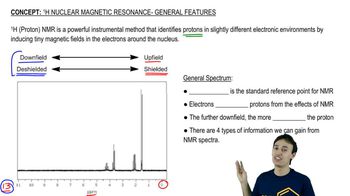
General NMR Features

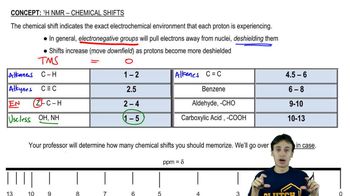
Chemical Shifts

Chemical shifts in NMR spectroscopy refer to the variation in resonance frequency of a nucleus due to its electronic environment. In 13C NMR, the chemical shift is influenced by factors such as electronegativity of nearby atoms and hybridization. This shift helps in distinguishing between different types of carbon atoms, such as those in aliphatic, aromatic, or functional groups, which is crucial for interpreting the spectrum.
Video consigliato:
11:44
1H NMR Chemical Shifts

Signal Multiplicity and Integration

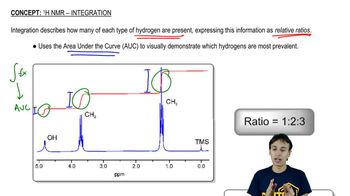
In NMR spectroscopy, the multiplicity of a signal indicates the number of neighboring hydrogen atoms (or other nuclei) that influence the resonance of a particular carbon atom. While 13C NMR typically shows singlets for each unique carbon environment, understanding the integration of these signals can provide insights into the number of equivalent carbons present. This concept is essential for accurately determining the number of signals in the spectrum.
Video consigliato:
06:46
1H NMR Integration