Ch. 15 - Reactions of Carboxylic Acids and Carboxylic Acid Derivatives
Bruice - Organic Chemistry 8th Edition
Bruice8th EditionOrganic ChemistryISBN: 9780135213711Non è quello che usi tu?Cambia libro di testo
Capitolo 15, Problema 74a

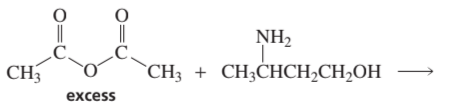
a. Identify the two products obtained from the following reaction:
Chemical reaction diagram showing reactants and products of nucleophilic acyl substitution with structural formulas.

Guida verificata passo dopo passo
1
Step 1: Analyze the reactants. The molecule on the left is an amino alcohol, containing both an amine (-NH2) group and a hydroxyl (-OH) group. The molecule on the right is acetic anhydride, which is a reactive compound used to acetylate functional groups. The reaction involves an excess of acetic anhydride.
Step 2: Identify the functional groups that will react. Acetic anhydride reacts with nucleophilic groups such as amines and alcohols. The amine group (-NH2) will undergo acetylation to form an amide, and the hydroxyl group (-OH) will undergo acetylation to form an ester.
Step 3: Predict the reaction at the amine group. The amine group reacts with acetic anhydride to form an amide. The general reaction is: \( \text{R-NH}_2 + (CH_3CO)_2O \rightarrow \text{R-NHCOCH}_3 + CH_3COOH \).
Step 4: Predict the reaction at the hydroxyl group. The hydroxyl group reacts with acetic anhydride to form an ester. The general reaction is: \( \text{R-OH} + (CH_3CO)_2O \rightarrow \text{R-OCOCH}_3 + CH_3COOH \).
Step 5: Combine the results. The final products are an amide formed from the acetylation of the amine group and an ester formed from the acetylation of the hydroxyl group. Both reactions produce acetic acid as a byproduct.

Risposta video verificata per un problema simile:

Questa soluzione video è stata consigliata dai nostri tutor come utile per risolvere questo problema.
Durata del video:
11m

Concetti chiave

Ecco i concetti essenziali che devi comprendere per rispondere correttamente alla domanda.

Nucleophilic Acyl Substitution

Nucleophilic acyl substitution is a fundamental reaction in organic chemistry where a nucleophile attacks the carbonyl carbon of an acyl compound, leading to the replacement of a leaving group. This reaction is common in the formation of carboxylic acid derivatives, such as esters and amides, and is characterized by the formation of a tetrahedral intermediate before the leaving group is expelled.
Video consigliato:
01:47
Nucleophiles and Electrophiles can react in Substitution Reactions.

Carboxylic Acid Derivatives

Carboxylic acid derivatives include compounds like esters, amides, and anhydrides, which can be formed from carboxylic acids. These derivatives retain the carbonyl group and can undergo nucleophilic acyl substitution reactions. Understanding the reactivity and properties of these derivatives is crucial for predicting the products of reactions involving them.
Video consigliato:
03:50
Intro to Carboxylic Acid Derivatives

Reaction Mechanism

A reaction mechanism describes the step-by-step process by which reactants are converted into products. In nucleophilic acyl substitution, the mechanism involves the nucleophile attacking the carbonyl carbon, forming a tetrahedral intermediate, followed by the elimination of a leaving group. Analyzing the mechanism helps in understanding the conditions required for the reaction and the nature of the products formed.
Video consigliato:
02:16
Heck Reaction Mechanism
Pratica correlata
Domanda del libro di testo

a. When a carboxylic acid is dissolved in isotopically labeled water (H2O18) and an acid catalyst is added, the label is incorporated into both oxygens of the acid. Propose a mechanism to account for this.

1049
views

Domanda del libro di testo

An aqueous solution of a primary or secondary amine reacts with an acyl chloride to form an amide as the major product. However, if the amine is ­tertiary, an amide is not formed. What product is formed? Explain.

1538
views
Domanda del libro di testo

Phosgene (COCl2) was used as a poison gas in World War I. What product would be formed from the reaction of phosgene with each of the ­following reagents?

c. excess propylamine

d. excess water

1514
views
Domanda del libro di testo

When a student treated butanedioic acid with thionyl chloride, she was surprised to find that the product she obtained was an anhydride rather than an acyl chloride. Propose a mechanism to explain why she obtained an anhydride.

1234
views
Domanda del libro di testo

a. When a carboxylic acid is dissolved in isotopically labeled water (H2O18) and an acid catalyst is added, the label is incorporated into both oxygens of the acid. Propose a mechanism to account for this.

c. If an ester is dissolved in isotopically labeled water (H2O18) and an acid catalyst is added, where will the label reside in the product?

1434
views
Domanda del libro di testo

When butanoic acid and 18O-labeled methanol react under acidic conditions, what compounds are labeled when the reaction has reached equilibrium?

1227
views