Ch. 15 - Reactions of Carboxylic Acids and Carboxylic Acid Derivatives
Bruice - Organic Chemistry 8th Edition
Bruice8th EditionOrganic ChemistryISBN: 9780135213711Non è quello che usi tu?Cambia libro di testo
Capitolo 15, Problema 43a

Propose a mechanism for the reaction of acetic anhydride with water.

Guida verificata passo dopo passo
1
Identify the functional groups in acetic anhydride. Acetic anhydride contains two acyl groups (R-C(=O)-) connected by an oxygen atom. It is a reactive compound that can undergo hydrolysis in the presence of water.
Recognize the nucleophile and electrophile. In this reaction, water acts as the nucleophile (electron-rich species) due to the lone pairs on oxygen, and the carbonyl carbon in acetic anhydride acts as the electrophile (electron-deficient species) due to the partial positive charge on the carbon.
Initiate the reaction by having the nucleophilic oxygen atom of water attack one of the carbonyl carbons in acetic anhydride. This forms a tetrahedral intermediate where the carbonyl oxygen becomes negatively charged.
Stabilize the tetrahedral intermediate by proton transfer. A proton from the water molecule can transfer to the leaving group (the oxygen atom bridging the two acyl groups), facilitating the cleavage of the bond between the carbonyl carbon and the bridging oxygen.
Conclude the mechanism by forming the final products. The reaction results in the formation of two molecules of acetic acid (CH₃COOH) as the acetic anhydride is hydrolyzed by water.

Risposta video verificata per un problema simile:

Questa soluzione video è stata consigliata dai nostri tutor come utile per risolvere questo problema.
Durata del video:
3m

Concetti chiave

Ecco i concetti essenziali che devi comprendere per rispondere correttamente alla domanda.

Acetic Anhydride Structure and Reactivity

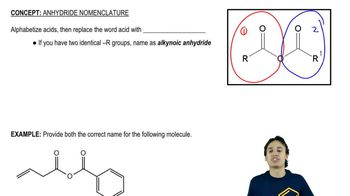
Acetic anhydride is a reactive organic compound derived from acetic acid, characterized by its anhydride functional group. Its structure consists of two acetyl groups connected by an oxygen atom, making it a good electrophile. This reactivity allows it to readily undergo hydrolysis when exposed to water, leading to the formation of acetic acid.
Video consigliato:
03:35
Anhydride Nomenclature

Nucleophilic Attack

In organic chemistry, a nucleophilic attack occurs when a nucleophile, which is a species with a high electron density, attacks an electrophile, which is electron-deficient. In the case of acetic anhydride reacting with water, the oxygen atom in water acts as a nucleophile, attacking the carbonyl carbon of the anhydride. This step is crucial for the hydrolysis mechanism.
Video consigliato:
08:27
Nucleophilic Addition

Hydrolysis Reaction Mechanism

Hydrolysis is a chemical reaction involving the breaking of a bond in a molecule using water. In the context of acetic anhydride, the hydrolysis mechanism involves the nucleophilic attack by water, leading to the formation of a tetrahedral intermediate, which subsequently collapses to yield two molecules of acetic acid. Understanding this mechanism is essential for predicting the products of the reaction.
Video consigliato:
Percorso guidato
3:09
Triacylglycerol Reactions: Hydrolysis Concept 3