Ch. 15 - Reactions of Carboxylic Acids and Carboxylic Acid Derivatives
Bruice - Organic Chemistry 8th Edition
Bruice8th EditionOrganic ChemistryISBN: 9780135213711Non è quello che usi tu?Cambia libro di testo
Capitolo 15, Problema 48b

Draw a structure for each of the following:
b. 3,3-dimethylhexanamide

Guida verificata passo dopo passo
1
Identify the parent chain: The parent chain is 'hexanamide,' which indicates a six-carbon chain (hexane) with an amide functional group (-CONH2) at the terminal carbon.
Number the carbon chain: Start numbering the chain from the carbon of the amide group (C1) to ensure the functional group gets the lowest possible number.
Locate the substituents: The name '3,3-dimethyl' indicates that there are two methyl groups (-CH3) attached to the third carbon of the parent chain.
Draw the structure: Begin by drawing the six-carbon chain with the amide group (-CONH2) at C1. Then, add two methyl groups to C3 of the chain.
Verify the structure: Ensure that the structure matches the IUPAC name, with the correct placement of the amide group and substituents, and that all carbons have the correct number of bonds (four for carbon).

Risposta video verificata per un problema simile:

Questa soluzione video è stata consigliata dai nostri tutor come utile per risolvere questo problema.
Durata del video:
3m

Concetti chiave

Ecco i concetti essenziali che devi comprendere per rispondere correttamente alla domanda.

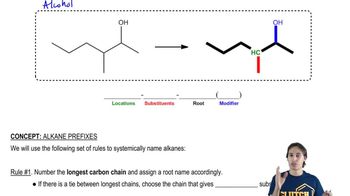
IUPAC Nomenclature

IUPAC nomenclature is a systematic method for naming organic chemical compounds. It provides rules for identifying the structure of a compound based on its molecular formula and functional groups. Understanding the naming conventions, such as identifying the longest carbon chain and substituents, is essential for accurately drawing chemical structures.
Video consigliato:
03:43
The different parts of an IUPAC name

Functional Groups

Functional groups are specific groups of atoms within molecules that are responsible for the characteristic chemical reactions of those molecules. In the case of amides, the functional group is characterized by a carbonyl group (C=O) directly attached to a nitrogen atom (N). Recognizing functional groups helps in understanding the reactivity and properties of the compound.
Video consigliato:
02:36
Identifying Functional Groups

Structural Representation

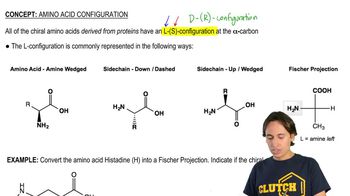
Structural representation refers to the way in which a chemical compound is depicted, showing the arrangement of atoms and the bonds between them. For 3,3-dimethylhexanamide, it is important to accurately represent the carbon backbone, the amide functional group, and the positions of the methyl substituents. This visual representation aids in comprehending the compound's geometry and potential reactivity.
Video consigliato:
05:09
Representations of L-Configuration