Ch. 15 - Reactions of Carboxylic Acids and Carboxylic Acid Derivatives
Bruice - Organic Chemistry 8th Edition
Bruice8th EditionOrganic ChemistryISBN: 9780135213711Non è quello che usi tu?Cambia libro di testo
Capitolo 15, Problema 49f

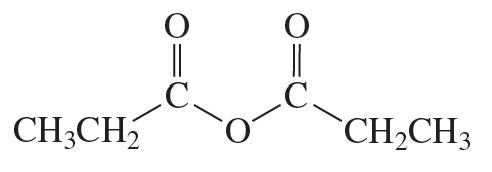
Name the following:
f. Chemical structure of an anhydride with two carbonyl groups and an oxygen bridge, labeled with ethyl groups.

Guida verificata passo dopo passo
1
Step 1: Identify the functional group present in the molecule. The structure contains two ester groups, which are characterized by the presence of a carbonyl group (C=O) bonded to an oxygen atom (O) that is further connected to another carbon chain.
Step 2: Determine the alkyl groups attached to the oxygen atoms in the ester functional groups. On the left side, the oxygen is bonded to a pentyl group (CH3CH2CH2CH2CH2). On the right side, the oxygen is bonded to another pentyl group (CH3CH2CH2CH2CH2).
Step 3: Identify the acyl groups (the part containing the carbonyl group and the adjacent carbon chain). Both acyl groups are derived from pentanoic acid (CH3CH2CH2CH2COOH), as they contain a five-carbon chain attached to the carbonyl group.
Step 4: Combine the names of the alkyl groups and the acyl groups to name the ester. The naming convention for esters is 'alkyl group' followed by 'acyl group' with the suffix '-oate'. Since both sides are identical, the name will reflect the symmetry of the molecule.
Step 5: Finalize the name by combining the components. The molecule is named as 'dipentyl pentanedioate', indicating two pentyl groups and a pentanedioic acid backbone.

Risposta video verificata per un problema simile:

Questa soluzione video è stata consigliata dai nostri tutor come utile per risolvere questo problema.
Durata del video:
3m

Concetti chiave

Ecco i concetti essenziali che devi comprendere per rispondere correttamente alla domanda.

Anhydrides

Anhydrides are organic compounds formed by the removal of water from two carboxylic acids. They typically have the general structure RCO-O-COR', where R and R' are hydrocarbon chains. Anhydrides are important in organic synthesis, often used to create esters or amides through reactions with alcohols or amines.
Video consigliato:
03:35
Anhydride Nomenclature

Nomenclature of Organic Compounds

The nomenclature of organic compounds follows specific rules set by the International Union of Pure and Applied Chemistry (IUPAC). For anhydrides, the naming convention involves identifying the parent carboxylic acids, removing 'acid' from their names, and adding 'anhydride' at the end. This systematic approach ensures clarity and consistency in naming organic molecules.
Video consigliato:
01:40
Defining meso compounds.

Functional Groups

Functional groups are specific groups of atoms within molecules that are responsible for the characteristic chemical reactions of those molecules. In the case of anhydrides, the functional group is the anhydride linkage (RCO-O-COR'), which influences the compound's reactivity and properties. Understanding functional groups is essential for predicting the behavior of organic compounds in chemical reactions.
Video consigliato:
02:36
Identifying Functional Groups