Ch. 15 - Reactions of Carboxylic Acids and Carboxylic Acid Derivatives
Bruice - Organic Chemistry 8th Edition
Bruice8th EditionOrganic ChemistryISBN: 9780135213711Non è quello che usi tu?Cambia libro di testo
Capitolo 15, Problema 57d

Using an alcohol for one method and an alkyl halide for the other, show two ways to make each of the following esters:
d. methyl phenylethanoate (odor of honey)

Guida verificata passo dopo passo
1
Step 1: Understand the structure of methyl phenylethanoate. It is an ester with the formula CH₃OCOCH₂C₆H₅. The ester functional group consists of a carbonyl group (C=O) bonded to an oxygen atom, which is further bonded to a methyl group (CH₃). The phenylethanoate portion contains a phenyl group (C₆H₅) attached to a two-carbon chain.
Step 2: Method 1 - Using an alcohol: To synthesize methyl phenylethanoate, start with phenylacetic acid (C₆H₅CH₂COOH) as the carboxylic acid. React phenylacetic acid with methanol (CH₃OH) in the presence of an acid catalyst, such as sulfuric acid (H₂SO₄). The acid catalyst promotes the esterification reaction, where the hydroxyl group (-OH) of the carboxylic acid is replaced by the methoxy group (-OCH₃) from methanol, forming the ester.
Step 3: Method 2 - Using an alkyl halide: Begin with phenylacetic acid (C₆H₅CH₂COOH) as the carboxylic acid. First, convert phenylacetic acid into its carboxylate salt by reacting it with a base, such as sodium hydroxide (NaOH), to form sodium phenylacetate (C₆H₅CH₂COO⁻Na⁺). Then, perform an SN2 reaction between sodium phenylacetate and methyl iodide (CH₃I). The methyl group from methyl iodide replaces the sodium ion, forming methyl phenylethanoate.
Step 4: Highlight the reaction conditions: For the esterification method using an alcohol, ensure the reaction is carried out under reflux to drive the equilibrium toward ester formation. For the alkyl halide method, ensure the reaction is performed in a polar aprotic solvent, such as acetone, to facilitate the SN2 mechanism.
Step 5: Summarize the two methods: The first method involves direct esterification of phenylacetic acid with methanol under acidic conditions. The second method involves converting phenylacetic acid to its carboxylate salt, followed by an SN2 reaction with methyl iodide. Both methods yield methyl phenylethanoate as the final product.

Risposta video verificata per un problema simile:

Questa soluzione video è stata consigliata dai nostri tutor come utile per risolvere questo problema.
Durata del video:
7m

Concetti chiave

Ecco i concetti essenziali che devi comprendere per rispondere correttamente alla domanda.

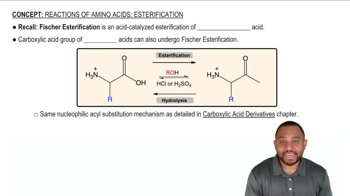
Esterification

Esterification is a chemical reaction that forms an ester from an alcohol and a carboxylic acid. This process typically involves the removal of a water molecule (condensation reaction) and can be catalyzed by an acid. Understanding this reaction is crucial for synthesizing esters, such as methyl phenylethanoate, from the appropriate reactants.
Video consigliato:
Percorso guidato
1:21
Reactions of Amino Acids: Esterification Concept 1

Nucleophilic Substitution

Nucleophilic substitution is a fundamental reaction mechanism in organic chemistry where a nucleophile replaces a leaving group in a molecule. In the context of ester synthesis, alkyl halides can undergo nucleophilic substitution with alcohols to form esters. This concept is essential for understanding how to create esters using alkyl halides.
Video consigliato:
01:47
Nucleophiles and Electrophiles can react in Substitution Reactions.

Reactivity of Alcohols and Alkyl Halides

The reactivity of alcohols and alkyl halides is pivotal in ester formation. Alcohols can act as nucleophiles, while alkyl halides serve as electrophiles. The choice of specific alcohols and alkyl halides influences the efficiency and outcome of the esterification process, making it important to select the right reactants for synthesizing methyl phenylethanoate.
Video consigliato:
01:52
How to name alkyl halides