

Ch. 15 - Reactions of Carboxylic Acids and Carboxylic Acid Derivatives
Bruice - Organic Chemistry 8th Edition
Bruice8th EditionOrganic ChemistryISBN: 9780135213711Non è quello che usi tu?Cambia libro di testo
Capitolo 15, Problema 72

When butanoic acid and 18O-labeled methanol react under acidic conditions, what compounds are labeled when the reaction has reached equilibrium?

Guida verificata passo dopo passo
1
Identify the reaction type: This is a Fischer esterification reaction, where a carboxylic acid (butanoic acid) reacts with an alcohol (18^O-labeled methanol) under acidic conditions to form an ester and water.
Write the general reaction mechanism: The carboxylic acid (butanoic acid) reacts with the alcohol (18^O-labeled methanol) in the presence of an acid catalyst. The hydroxyl group (-OH) of the carboxylic acid is replaced by the alkoxy group (-OCH3) from the alcohol, forming an ester (methyl butanoate). Water is also produced as a byproduct.
Track the labeled oxygen atom: The 18^O label in methanol is part of the -OCH3 group. During the reaction, this labeled oxygen becomes part of the ester product (methyl butanoate). The water molecule formed will contain the oxygen atom originally from the carboxylic acid (-OH group).
Consider equilibrium: At equilibrium, both the ester (methyl butanoate) and water are present. The labeled oxygen (18^O) will be found in the ester product, specifically in the -OCH3 group, while the water molecule will not contain the labeled oxygen.
Summarize the labeled compounds: At equilibrium, the compound labeled with 18^O is the ester (methyl butanoate), as the labeled oxygen from methanol is incorporated into the ester structure.

Risposta video verificata per un problema simile:

Questa soluzione video è stata consigliata dai nostri tutor come utile per risolvere questo problema.
Durata del video:
4m

Concetti chiave

Ecco i concetti essenziali che devi comprendere per rispondere correttamente alla domanda.

Acid-Base Reactions

Acid-base reactions involve the transfer of protons (H+) between reactants. In the context of butanoic acid and methanol, the acidic conditions facilitate the protonation of the alcohol, making it a better nucleophile. Understanding this concept is crucial for predicting how the reactants will interact and form new products.
Video consigliato:
02:49
The Lewis definition of acids and bases.

Isotope Labeling

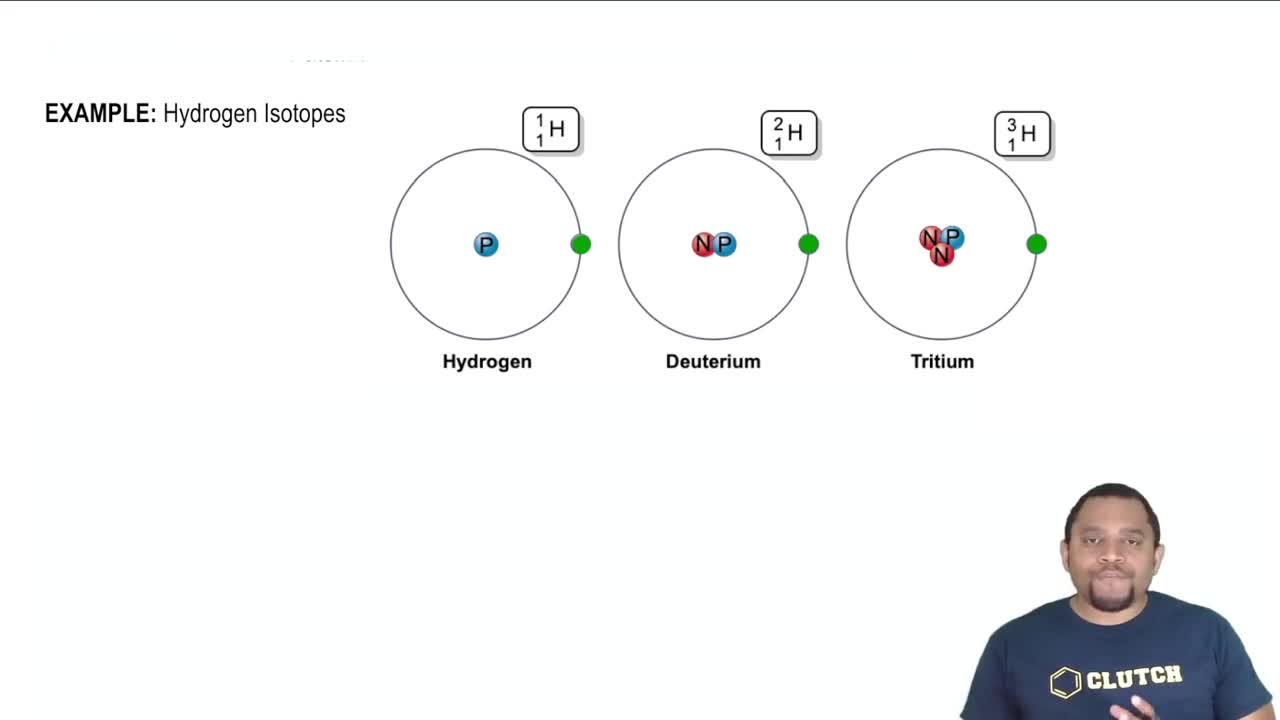
Isotope labeling, such as using 18^O in methanol, allows chemists to track the movement of atoms during a chemical reaction. In this case, the 18^O label will help identify which compounds incorporate the oxygen from methanol after the reaction. This concept is essential for understanding how the labeled atoms are distributed among the products.
Video consigliato:
03:06
Understanding the hydrogen isotopes.

Equilibrium in Chemical Reactions

Chemical equilibrium occurs when the rates of the forward and reverse reactions are equal, resulting in constant concentrations of reactants and products. In the reaction between butanoic acid and methanol, knowing how equilibrium affects the distribution of labeled and unlabeled compounds is vital for predicting the final outcome of the reaction.
Video consigliato:
Percorso guidato
3:11
Chemical Reactions of Phosphate Anhydrides Concept 1