Ch. 17 - Reactions at the Alpha-Carbon
Bruice - Organic Chemistry 8th Edition
Bruice8th EditionOrganic ChemistryISBN: 9780135213711Non è quello che usi tu?Cambia libro di testo
Capitolo 17, Problema 72a

Draw the products of the following reactions:
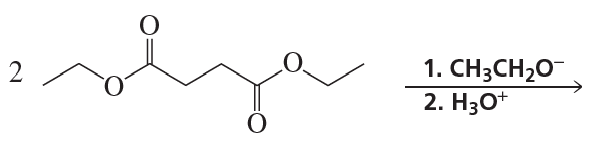
a. Chemical structure illustrating a Claisen condensation reaction with reactants and products labeled.

Guida verificata passo dopo passo
1
Step 1: Analyze the structure of the starting compound. The molecule contains two ester groups separated by a methylene chain. Each ester group has a carbonyl carbon attached to an oxygen atom and a methyl group.
Step 2: Consider the first reagent, CH3O⁻ (methoxide ion). Methoxide is a strong nucleophile and base. It will likely initiate a nucleophilic attack or deprotonation. In this case, it will deprotonate the alpha-hydrogen (hydrogen on the carbon adjacent to the carbonyl group) of one of the esters, forming an enolate ion.
Step 3: The enolate ion formed is a resonance-stabilized intermediate. The negative charge on the alpha-carbon can attack the carbonyl carbon of the second ester group, leading to an intramolecular reaction. This step forms a cyclic intermediate.
Step 4: After the intramolecular attack, the cyclic intermediate undergoes protonation when HCl is added in the second step. HCl provides protons to stabilize the intermediate and complete the reaction.
Step 5: The final product is a cyclic β-keto ester. The reaction results in the formation of a ring structure due to the intramolecular attack, and the ester group remains intact in the product.

Risposta video verificata per un problema simile:

Questa soluzione video è stata consigliata dai nostri tutor come utile per risolvere questo problema.
Durata del video:
4m

Concetti chiave

Ecco i concetti essenziali che devi comprendere per rispondere correttamente alla domanda.

Claisen Condensation

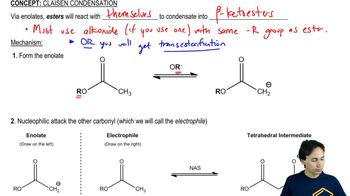
Claisen condensation is a reaction between two esters or an ester and a carbonyl compound in the presence of a strong base, leading to the formation of a β-keto ester or a β-diketone. This reaction involves the nucleophilic attack of an enolate ion on the carbonyl carbon of another ester, followed by the elimination of an alcohol. Understanding this mechanism is crucial for predicting the products of the reaction shown.
Video consigliato:
08:28
Claisen Condensation

Enolate Ion Formation

Enolate ions are formed when a base abstracts a proton from the α-carbon of a carbonyl compound, resulting in a resonance-stabilized anion. This species is a key intermediate in many organic reactions, including the Claisen condensation. The stability and reactivity of the enolate ion determine the course of the reaction, making it essential to grasp how to generate and utilize these intermediates effectively.
Video consigliato:
02:26
Formation of Enolates

Acid-Base Reactions

Acid-base reactions involve the transfer of protons (H+) between reactants, which can influence the outcome of organic reactions. In the context of the given reaction, HCl serves as an acid that can protonate the enolate ion or other intermediates, stabilizing them or facilitating further reactions. Understanding the role of acids and bases is vital for predicting product formation and reaction pathways in organic chemistry.
Video consigliato:
02:49
The Lewis definition of acids and bases.