Ch. 17 - Reactions at the Alpha-Carbon
Bruice - Organic Chemistry 8th Edition
Bruice8th EditionOrganic ChemistryISBN: 9780135213711Non è quello che usi tu?Cambia libro di testo
Capitolo 17, Problema 55b

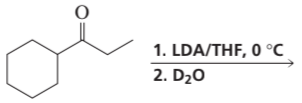
Draw the products of the following reactions:
b.

Guida verificata passo dopo passo
1
Step 1: Identify the starting material, which is a ketone with a cyclopentane ring and a methyl group attached to the alpha-carbon.
Step 2: Recognize the reagents used in the reaction. LDA (Lithium Diisopropylamide) is a strong, non-nucleophilic base that will deprotonate the most acidic hydrogen, typically the alpha-hydrogen of the ketone. THF is the solvent, and D2O is heavy water used for deuterium exchange.
Step 3: Determine the site of deprotonation. The alpha-hydrogen adjacent to the carbonyl group is acidic due to resonance stabilization of the resulting enolate ion. LDA will remove this hydrogen, forming an enolate intermediate.
Step 4: Analyze the enolate intermediate. The enolate ion has a resonance structure where the negative charge is delocalized between the alpha-carbon and the oxygen atom of the carbonyl group.
Step 5: Predict the final product. The enolate reacts with D2O, leading to the replacement of the alpha-hydrogen with a deuterium atom (D). The final product is the deuterium-labeled ketone.

Risposta video verificata per un problema simile:

Questa soluzione video è stata consigliata dai nostri tutor come utile per risolvere questo problema.
Durata del video:
2m

Concetti chiave

Ecco i concetti essenziali che devi comprendere per rispondere correttamente alla domanda.

Enolate Formation

Enolate formation is a key step in organic reactions involving carbonyl compounds. It occurs when a base, such as LDA (Lithium diisopropylamide), abstracts an alpha hydrogen from a carbonyl compound, resulting in the formation of an enolate ion. This ion is resonance-stabilized and can act as a nucleophile in subsequent reactions, allowing for the formation of new carbon-carbon bonds.
Video consigliato:
02:26
Formation of Enolates

Deuteration

Deuteration is the process of replacing hydrogen atoms in a molecule with deuterium, a heavier isotope of hydrogen. In the context of the reaction shown, the use of D2O (deuterated water) allows for the incorporation of deuterium into the enolate product. This is significant in mechanistic studies and can help trace reaction pathways or confirm the formation of specific intermediates.

Reaction Conditions

The reaction conditions, including the solvent (THF) and temperature (0°C), play a crucial role in the outcome of organic reactions. THF is a polar aprotic solvent that stabilizes the enolate ion, while the low temperature helps control the reaction rate and minimize side reactions. Understanding these conditions is essential for predicting the products and optimizing yields in synthetic organic chemistry.
Video consigliato:
Percorso guidato
1:18
EAS Reactions of Pyridine Example 1