Ch. 17 - Reactions at the Alpha-Carbon
Bruice - Organic Chemistry 8th Edition
Bruice8th EditionOrganic ChemistryISBN: 9780135213711Non è quello che usi tu?Cambia libro di testo
Capitolo 17, Problema 53d

Draw the products of the following reactions:
d. diethyl 1,2-benzenedicarboxylate + sodium ethoxide: (1) slow addition of ethyl acetate; (2) HCl

Guida verificata passo dopo passo
1
Step 1: Recognize the reaction type. This is a Claisen condensation reaction, where diethyl 1,2-benzenedicarboxylate (an ester) reacts with ethyl acetate (another ester) in the presence of a strong base (sodium ethoxide). The reaction involves the formation of a β-keto ester intermediate.
Step 2: Deprotonation of the α-hydrogen. Sodium ethoxide (NaOEt) acts as a base and deprotonates the α-hydrogen of ethyl acetate, forming an enolate ion. The enolate ion is a nucleophile that will attack the electrophilic carbonyl carbon of the diethyl 1,2-benzenedicarboxylate.
Step 3: Nucleophilic attack. The enolate ion attacks one of the ester carbonyl carbons in diethyl 1,2-benzenedicarboxylate, leading to the formation of a tetrahedral intermediate. This intermediate then collapses, expelling an ethoxide ion (EtO⁻) as a leaving group and forming a β-keto ester.
Step 4: Acidic workup. After the slow addition of ethyl acetate and completion of the reaction, the mixture is treated with HCl. The acidic workup neutralizes the base and stabilizes the β-keto ester product.
Step 5: Draw the product. The final product is a β-keto ester where the ethyl acetate has been added to the diethyl 1,2-benzenedicarboxylate framework. Ensure to include the aromatic ring and the ester groups in the structure.

Risposta video verificata per un problema simile:

Questa soluzione video è stata consigliata dai nostri tutor come utile per risolvere questo problema.
Durata del video:
9m

Concetti chiave

Ecco i concetti essenziali che devi comprendere per rispondere correttamente alla domanda.

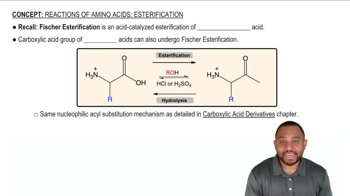
Esterification Reaction

Esterification is a chemical reaction that forms an ester from an alcohol and a carboxylic acid. In this context, diethyl 1,2-benzenedicarboxylate reacts with sodium ethoxide, which acts as a base, facilitating the nucleophilic attack of ethyl acetate on the carbonyl carbon of the ester. This reaction is crucial for understanding how the products are formed in the given reaction sequence.
Video consigliato:
Percorso guidato
1:21
Reactions of Amino Acids: Esterification Concept 1

Nucleophilic Substitution

Nucleophilic substitution is a fundamental reaction mechanism in organic chemistry where a nucleophile replaces a leaving group in a molecule. In this case, the ethoxide ion acts as a nucleophile, attacking the electrophilic carbon of the diethyl 1,2-benzenedicarboxylate. Understanding this mechanism is essential for predicting the products of the reaction after the slow addition of ethyl acetate.
Video consigliato:
01:47
Nucleophiles and Electrophiles can react in Substitution Reactions.

Acid-Base Reaction

An acid-base reaction involves the transfer of protons (H+) between reactants. After the nucleophilic substitution, the addition of HCl serves to protonate the alkoxide ion formed, converting it back to an alcohol. This step is important for completing the reaction and understanding the final products, as it influences the stability and reactivity of the intermediates.
Video consigliato:
02:49
The Lewis definition of acids and bases.