Ch. 17 - Reactions at the Alpha-Carbon
Bruice - Organic Chemistry 8th Edition
Bruice8th EditionOrganic ChemistryISBN: 9780135213711Non è quello che usi tu?Cambia libro di testo
Capitolo 17, Problema 5a

Rank the compounds in each of the following groups from strongest acid to weakest acid:
a. Chemical structures of compounds with labels: CH2=CH2, CH3CH3, and HC≡CH, illustrating acidity ranking.

Guida verificata passo dopo passo
1
Step 1: Identify the functional groups in each compound. Compound (a) contains a terminal alkyne group (-C≡CH), compound (b) is an alkane with no acidic hydrogen, compound (c) contains a carbonyl group (aldehyde), and compound (d) contains a terminal alkyne group (-C≡CH).
Step 2: Recall the general trend in acidity. Terminal alkynes are more acidic than alkanes due to the sp-hybridized carbon, which stabilizes the conjugate base. Aldehydes are less acidic than terminal alkynes but more acidic than alkanes.
Step 3: Compare the acidity of the compounds based on their functional groups. Terminal alkynes (a and d) are expected to be the most acidic, followed by the aldehyde (c), and finally the alkane (b), which is the least acidic.
Step 4: Consider the inductive effects and hybridization. The sp-hybridized carbon in terminal alkynes contributes to their acidity, while the sp3-hybridized carbons in alkanes make them the least acidic. The carbonyl group in aldehydes contributes to moderate acidity due to resonance stabilization of the conjugate base.
Step 5: Rank the compounds from strongest acid to weakest acid based on the analysis: (a) ≈ (d) > (c) > (b).

Risposta video verificata per un problema simile:

Questa soluzione video è stata consigliata dai nostri tutor come utile per risolvere questo problema.
Durata del video:
4m

Concetti chiave

Ecco i concetti essenziali che devi comprendere per rispondere correttamente alla domanda.

Acidity in Organic Compounds

Acidity in organic chemistry refers to the ability of a compound to donate a proton (H+). The strength of an acid is influenced by the stability of its conjugate base; the more stable the conjugate base, the stronger the acid. Factors affecting acidity include electronegativity, resonance, and hybridization of the atom bearing the acidic proton.
Video consigliato:
01:40
Defining meso compounds.

Hybridization and Acidity

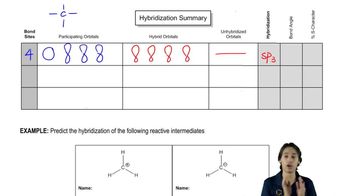
The hybridization of the carbon atom attached to the acidic hydrogen significantly affects acidity. sp-hybridized carbons (as in alkynes) are more acidic than sp2 (alkenes) and sp3 (alkanes) because the greater s-character in sp hybridization leads to a more stable conjugate base. This stability arises from the closer proximity of the negative charge to the nucleus in sp-hybridized carbons.
Video consigliato:
10:43
Using bond sites to predict hybridization

Resonance Stabilization

Resonance stabilization occurs when a compound can delocalize electrons across multiple structures, enhancing stability. In the context of acidity, if the conjugate base can be stabilized by resonance, the original compound is a stronger acid. For example, carboxylic acids exhibit resonance stabilization, making them stronger acids compared to alkenes or alkynes without such stabilization.
Video consigliato:
03:43
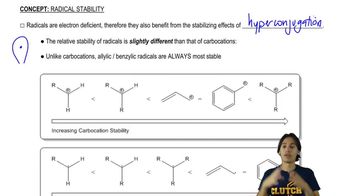
The radical stability trend.