Ch. 17 - Reactions at the Alpha-Carbon
Bruice - Organic Chemistry 8th Edition
Bruice8th EditionOrganic ChemistryISBN: 9780135213711Non è quello che usi tu?Cambia libro di testo
Capitolo 17, Problema 5c

Rank the compounds in each of the following groups from strongest acid to weakest acid:
c. Chemical structures of three compounds for ranking acidity, featuring carbon rings and functional groups.

Guida verificata passo dopo passo
1
Step 1: Analyze the functional groups present in each compound. Compound (a) contains a ketone group (C=O), compound (b) contains an ester group (C=O and C-O), and compound (c) contains an amide group (C=O and NH).
Step 2: Recall the general trend in acidity for these functional groups. Ketones are less acidic compared to esters, and amides are generally the least acidic due to the electron-donating nature of the nitrogen atom.
Step 3: Consider the resonance stabilization of the conjugate base formed after deprotonation. Esters can stabilize the conjugate base better than ketones due to the additional oxygen atom, while amides have reduced resonance stabilization due to the nitrogen's lone pair.
Step 4: Evaluate the inductive effects. The electronegativity of oxygen in esters contributes to a stronger inductive effect, increasing acidity compared to ketones. In amides, the nitrogen's lone pair reduces the inductive effect, making them less acidic.
Step 5: Rank the compounds based on their acidity: Compound (b) (ester) is the strongest acid, followed by compound (a) (ketone), and compound (c) (amide) is the weakest acid.

Risposta video verificata per un problema simile:

Questa soluzione video è stata consigliata dai nostri tutor come utile per risolvere questo problema.
Durata del video:
5m

Concetti chiave

Ecco i concetti essenziali che devi comprendere per rispondere correttamente alla domanda.

Acidity and pKa

Acidity in organic chemistry is often measured by the pKa value, which indicates the strength of an acid. A lower pKa value corresponds to a stronger acid, meaning it can donate protons (H+) more readily. Understanding the relationship between structure and acidity is crucial for ranking compounds based on their acidic strength.
Video consigliato:
07:45
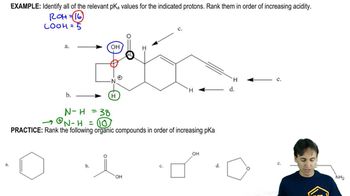
Identifying pKa values

Resonance Stabilization

Resonance stabilization occurs when a molecule can be represented by multiple valid Lewis structures, allowing for the delocalization of electrons. This delocalization can stabilize the conjugate base formed after deprotonation, enhancing the acidity of the original compound. Compounds with greater resonance stabilization of their conjugate bases tend to be stronger acids.
Video consigliato:
03:43
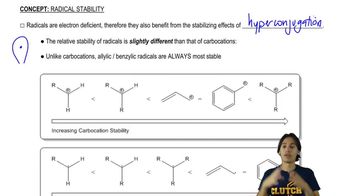
The radical stability trend.

Inductive Effect

The inductive effect refers to the electron-withdrawing or electron-donating influence of substituents on a molecule. Electronegative atoms or groups can stabilize negative charges on conjugate bases through inductive withdrawal, increasing acidity. Conversely, electron-donating groups can destabilize the conjugate base, leading to weaker acids.
Video consigliato:
01:47
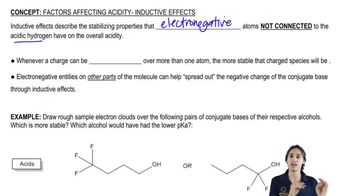
Understanding the Inductive Effect.