
Ch. 17 - Reactions at the Alpha-Carbon
Bruice - Organic Chemistry 8th Edition
Bruice8th EditionOrganic ChemistryISBN: 9780135213711Non è quello che usi tu?Cambia libro di testo
Capitolo 17, Problema 65a

There are other condensation reactions similar to the aldol and Claisen condensations:
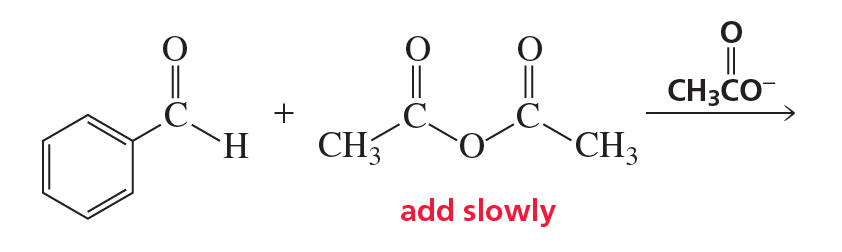
a. The Perkin condensation is the condensation of an aromatic aldehyde and acetic anhydride. Draw the product obtained from the following Perkin condensation:
Chemical reaction diagram illustrating the Perkin condensation between an aromatic aldehyde and acetic anhydride.

Guida verificata passo dopo passo
1
Identify the reactants in the Perkin condensation: an aromatic aldehyde (e.g., benzaldehyde) and acetic anhydride. The reaction typically occurs in the presence of a base, such as sodium acetate, which facilitates the reaction.
Understand the mechanism: The base deprotonates the methyl group of acetic anhydride, forming an enolate ion. This enolate ion acts as a nucleophile in the reaction.
The enolate ion attacks the carbonyl carbon of the aromatic aldehyde, forming a β-hydroxy intermediate. This step is analogous to the aldol addition step in aldol condensation.
The β-hydroxy intermediate undergoes dehydration (loss of water) to form an α,β-unsaturated carbonyl compound. This step is driven by the formation of a conjugated system, which is thermodynamically stable.
Draw the final product: The product will be an α,β-unsaturated carbonyl compound where the aromatic ring is conjugated with the double bond and the carbonyl group. Ensure the structure reflects the correct connectivity and stereochemistry, if applicable.

Risposta video verificata per un problema simile:

Questa soluzione video è stata consigliata dai nostri tutor come utile per risolvere questo problema.

Concetti chiave

Ecco i concetti essenziali che devi comprendere per rispondere correttamente alla domanda.

Perkin Condensation

The Perkin condensation is a reaction that involves the condensation of an aromatic aldehyde with an anhydride, typically acetic anhydride, in the presence of a base. This reaction results in the formation of α,β-unsaturated carboxylic acids. Understanding this reaction is crucial for predicting the structure of the product formed from the specific reactants provided in the question.
Video consigliato:
05:53
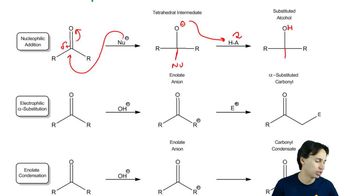
Condensation Reactions

Aromatic Aldehydes

Aromatic aldehydes are organic compounds that contain a carbonyl group (C=O) bonded to a carbon atom of an aromatic ring. They play a significant role in various organic reactions, including the Perkin condensation. Recognizing the structure and reactivity of aromatic aldehydes is essential for determining the outcome of the condensation reaction.
Video consigliato:
01:34
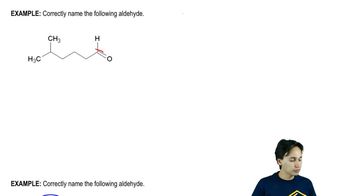
Name the aldehyde

Acetic Anhydride

Acetic anhydride is a reactive acylating agent commonly used in organic synthesis, particularly in condensation reactions. It can donate an acetyl group (CH3CO-) to other molecules, facilitating the formation of new carbon-carbon bonds. Familiarity with acetic anhydride's properties and its role in the Perkin condensation is vital for understanding the mechanism and predicting the product.
Video consigliato:
03:35
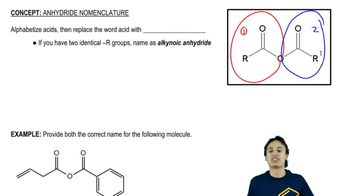
Anhydride Nomenclature