Ch. 18 - Reactions of Benzene and Substituted Benzenes
Bruice - Organic Chemistry 8th Edition
Bruice8th EditionOrganic ChemistryISBN: 9780135213711Non è quello che usi tu?Cambia libro di testo
Capitolo 18, Problema 22

a. Does a coupling reaction have to be used to synthesize p-dipropylbenzene?
b. Can a coupling reaction be used to synthesize p-dipropylbenzene?

Guida verificata passo dopo passo
1
Step 1: Understand the structure of p-dipropylbenzene. It is a benzene ring with two propyl groups (-CH2CH2CH3) attached at the para positions (1,4 positions on the benzene ring).
Step 2: Analyze part (a). A coupling reaction typically involves the formation of a new carbon-carbon bond between two organic fragments, often using a catalyst. Consider whether a coupling reaction is necessary to attach the two propyl groups to the benzene ring. Note that simpler methods, such as Friedel-Crafts alkylation, might be more direct for this synthesis.
Step 3: Analyze part (b). Determine if a coupling reaction could theoretically be used to synthesize p-dipropylbenzene. For example, you could consider using a Suzuki or Heck coupling reaction, which are common in organic synthesis, to attach the propyl groups to the benzene ring.
Step 4: Evaluate the practicality of using a coupling reaction. While it might be possible to use a coupling reaction, consider whether it is the most efficient or practical method compared to other synthetic routes, such as direct alkylation.
Step 5: Conclude by comparing the necessity and feasibility of using a coupling reaction for this synthesis. Highlight that while a coupling reaction could be used, it may not be the most straightforward or commonly employed method for synthesizing p-dipropylbenzene.

Risposta video verificata per un problema simile:

Questa soluzione video è stata consigliata dai nostri tutor come utile per risolvere questo problema.
Durata del video:
4m

Concetti chiave

Ecco i concetti essenziali che devi comprendere per rispondere correttamente alla domanda.

Coupling Reactions

Coupling reactions are organic reactions where two fragments are joined together, often involving the formation of a new carbon-carbon bond. Common examples include Suzuki and Heck reactions, which utilize transition metals as catalysts. Understanding these reactions is crucial for synthesizing complex organic molecules, such as p-dipropylbenzene, from simpler precursors.
Video consigliato:
02:54
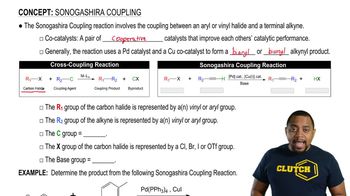
Sonogashira Coupling Reaction

Substitution Reactions

Substitution reactions involve replacing one atom or group in a molecule with another. In the context of aromatic compounds, electrophilic aromatic substitution (EAS) is a key mechanism that allows for the introduction of substituents onto the benzene ring. This concept is essential for understanding how to synthesize p-dipropylbenzene through direct substitution methods rather than coupling.
Video consigliato:
01:34
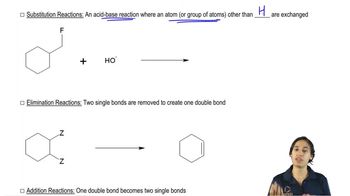
Recognizing Substitution Reactions.

Aromatic Compounds

Aromatic compounds are cyclic, planar molecules with delocalized pi electrons, which confer unique stability and reactivity. The properties of aromaticity influence how these compounds react, particularly in substitution reactions. Recognizing the structure and reactivity of aromatic compounds is vital for determining the feasibility of synthesizing p-dipropylbenzene through various organic reactions.
Video consigliato:
08:19
Intro to Aromaticity