Ch. 18 - Reactions of Benzene and Substituted Benzenes
Bruice - Organic Chemistry 8th Edition
Bruice8th EditionOrganic ChemistryISBN: 9780135213711Non è quello che usi tu?Cambia libro di testo
Capitolo 18, Problema 61

Describe two ways to prepare anisole from benzene.

Guida verificata passo dopo passo
1
Step 1: **Preparation via Friedel-Crafts Alkylation and Williamson Ether Synthesis**: Start with benzene. Perform a Friedel-Crafts alkylation reaction by reacting benzene with methyl chloride (CH₃Cl) in the presence of a Lewis acid catalyst like AlCl₃. This will yield toluene (methylbenzene). Next, oxidize the methyl group of toluene to a phenol group using an oxidizing agent like KMnO₄. Finally, perform a Williamson Ether Synthesis by reacting phenol with methyl iodide (CH₃I) in the presence of a strong base like NaOH to form anisole (methoxybenzene).
Step 2: **Preparation via Phenol Methylation**: Start with benzene and perform a nitration reaction by reacting benzene with a mixture of concentrated HNO₃ and H₂SO₄ to form nitrobenzene. Reduce nitrobenzene to aniline (aminobenzene) using a reducing agent like Sn/HCl. Convert aniline to phenol by diazotization (using NaNO₂ and HCl at 0-5°C) followed by hydrolysis. Finally, methylate phenol by reacting it with dimethyl sulfate ((CH₃O)₂SO₂) or methyl iodide (CH₃I) in the presence of a base like NaOH to form anisole.
Step 3: **Key Reaction Mechanisms**: In the Friedel-Crafts alkylation, the Lewis acid catalyst (AlCl₃) generates a highly reactive electrophile (CH₃⁺) that reacts with benzene to form toluene. In the Williamson Ether Synthesis, the phenoxide ion (generated by deprotonating phenol with NaOH) acts as a nucleophile and attacks the methyl iodide (CH₃I) to form anisole.
Step 4: **Alternative Reagents and Conditions**: For the phenol methylation step, dimethyl sulfate ((CH₃O)₂SO₂) can also be used as a methylating agent instead of methyl iodide. Additionally, other oxidizing agents like CrO₃ or PCC can be used to oxidize toluene to phenol.
Step 5: **Safety and Environmental Considerations**: Ensure proper handling of reagents like AlCl₃, H₂SO₄, and dimethyl sulfate, as they are highly reactive and hazardous. Use appropriate safety equipment and dispose of waste according to environmental regulations.

Risposta video verificata per un problema simile:

Questa soluzione video è stata consigliata dai nostri tutor come utile per risolvere questo problema.
Durata del video:
6m

Concetti chiave

Ecco i concetti essenziali che devi comprendere per rispondere correttamente alla domanda.

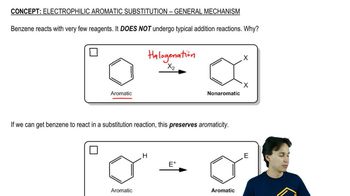
Electrophilic Aromatic Substitution

Electrophilic aromatic substitution (EAS) is a fundamental reaction in organic chemistry where an electrophile replaces a hydrogen atom on an aromatic ring. In the case of preparing anisole from benzene, EAS can occur through the introduction of a methoxy group (-OCH3) via the reaction of benzene with an electrophile such as methyl iodide in the presence of a strong base, which generates the necessary electrophile.
Video consigliato:
03:07
EAS Review

Friedel-Crafts Alkylation

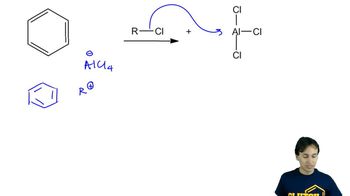
Friedel-Crafts alkylation is a specific type of electrophilic aromatic substitution that involves the addition of an alkyl group to an aromatic ring. To prepare anisole, benzene can react with an alkyl halide (like methyl chloride) in the presence of a Lewis acid catalyst (such as AlCl3), which facilitates the formation of the alkyl cation that subsequently attaches to the benzene ring, forming an alkylated product that can be further converted to anisole.
Video consigliato:
06:30
Friedel-Crafts Alkylation

Methoxy Group Introduction

The methoxy group (-OCH3) is a common functional group in organic chemistry that can be introduced into aromatic compounds through various methods. In the context of preparing anisole, the methoxy group can be introduced via the reaction of benzene with dimethyl sulfate or methyl iodide in the presence of a base, leading to the formation of anisole. Understanding the reactivity and stability of the methoxy group is crucial for predicting the outcomes of these reactions.
Video consigliato:
Percorso guidato
1:49
Introduction to Polymers Concept 1