Ch. 18 - Reactions of Benzene and Substituted Benzenes
Bruice - Organic Chemistry 8th Edition
Bruice8th EditionOrganic ChemistryISBN: 9780135213711Non è quello che usi tu?Cambia libro di testo
Capitolo 18, Problema 41f

Design a synthesis for each of the following, using an intramolecular reaction:
f.

Guida verificata passo dopo passo
1
Step 1: Analyze the target molecule. The structure contains a tetrahydrofuran ring (a five-membered cyclic ether) with a hydroxyl group attached to a propyl chain. This suggests the use of an intramolecular reaction to form the cyclic ether.
Step 2: Identify the precursor molecule. To form the tetrahydrofuran ring via an intramolecular reaction, the precursor should contain both a hydroxyl group and a leaving group (such as a halide or tosylate) on the same molecule, separated by a suitable chain length.
Step 3: Propose the starting material. A suitable starting material could be 4-hydroxybutyl bromide or 4-hydroxybutyl tosylate. This molecule contains both the hydroxyl group and the leaving group required for the intramolecular reaction.
Step 4: Describe the reaction mechanism. The intramolecular reaction proceeds via an SN2 mechanism, where the hydroxyl group is deprotonated to form an alkoxide ion (a strong nucleophile). The alkoxide then attacks the carbon attached to the leaving group, forming the cyclic ether (tetrahydrofuran).
Step 5: Outline the synthesis steps. First, prepare the precursor by functionalizing 1,4-butanediol to introduce a leaving group (e.g., bromide or tosylate) on one end. Then, treat the precursor with a strong base (e.g., NaH or KOH) to deprotonate the hydroxyl group and initiate the intramolecular SN2 reaction, yielding the target molecule.

Risposta video verificata per un problema simile:

Questa soluzione video è stata consigliata dai nostri tutor come utile per risolvere questo problema.
Durata del video:
5m

Concetti chiave

Ecco i concetti essenziali che devi comprendere per rispondere correttamente alla domanda.

Intramolecular Reactions

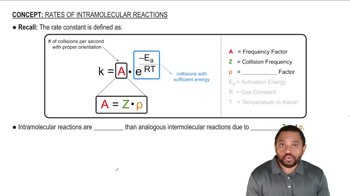
Intramolecular reactions occur when a reaction takes place within a single molecule, leading to the formation of a cyclic structure or a new functional group. These reactions often involve the formation of a bond between two reactive sites within the same molecule, which can significantly enhance the efficiency of the synthesis process. Understanding the mechanisms and conditions that favor intramolecular reactions is crucial for designing effective synthetic pathways.
Video consigliato:
Percorso guidato
2:29
Rates of Intramolecular Reactions Concept 1

Synthesis Design

Synthesis design in organic chemistry involves planning a series of chemical reactions to construct a specific target molecule from simpler starting materials. This process requires knowledge of reaction mechanisms, functional group transformations, and the ability to predict the outcomes of reactions. A well-designed synthesis not only considers the efficiency and yield but also the selectivity and safety of the reactions involved.
Video consigliato:
Percorso guidato
1:16
Synthesis of Amino Acids: Strecker Synthesis Example 1

Functional Groups

Functional groups are specific groups of atoms within molecules that are responsible for the characteristic chemical reactions of those molecules. They dictate the reactivity and properties of organic compounds, making it essential to identify and manipulate them during synthesis. Understanding how different functional groups interact and transform during intramolecular reactions is key to successfully designing a synthesis.
Video consigliato:
02:36
Identifying Functional Groups